
Ball Transfer Unit
AstraRoll Ball Transfer Units are engineered for smooth, omnidirectional movement of loads in conveyor lines, assembly stations, logistics systems and automated material handling. Using precision ball bearings and durable ball materials, they reduce friction and allow heavy or awkward loads to rotate, align and transfer with minimal effort. As part of our industrial roller wheel range, Ball Transfer Units can be matched with nylon, PU, steel or stainless steel configurations and customized for load capacity, mounting and environment. Explore our Ball Transfer Unit solutions for reliable, low-maintenance omnidirectional conveying.
Ball Transfer Unit FAQs
AstraRoll is a manufacturer, not a trading company. We produce Ball Transfer Units and industrial roller wheels in our own factory, with in-house machining, assembly and quality inspection. This means we can support both OEM projects and wholesale/distributor orders. For bulk orders, we offer volume-based pricing, stable production capacity and consistent specifications from batch to batch. If you are a distributor or need recurring supply, we can discuss annual agreements, stock planning and private-label packaging.
Our Ball Transfer Units are available in multiple configurations to match different loads, speeds and environments. Key selection factors include load capacity per unit, ball diameter, ball material (carbon steel, stainless steel, nylon or POM), housing material, mounting type (stud, flange, spring-loaded or recessed) and whether the application requires corrosion resistance or low-noise operation. For light-duty logistics and assembly tables, nylon or POM balls are often sufficient; for heavy loads and harsh environments, steel or stainless steel units are recommended. Our engineering team can recommend the right model based on your load, surface, speed and working environment - just share your application details.
Yes. As a manufacturer, we support customization of dimensions, ball material, housing material, mounting structure, load rating and surface treatment. We can work from your drawings, samples or application requirements. MOQ depends on the level of customization and whether the item is a standard model or a fully custom design - standard units can be supplied in flexible quantities, while custom units may require a minimum production batch. Lead time is confirmed at quotation based on quantity, material availability and customization scope. For urgent projects, we can advise on the fastest feasible schedule.
Quality control covers incoming material inspection, in-process checks and final inspection before shipment. For Ball Transfer Units, critical checks include ball roundness, rotation smoothness, load capacity, housing dimensional accuracy and surface finish. Our QC lab uses precision measuring instruments and hardness testers, and we can provide inspection reports, material certificates and certificates of conformity on request. If your market or industry requires specific standards (for example food-grade, corrosion-resistant or automotive-related requirements), tell us at the inquiry stage so we can confirm material and documentation compliance.
We support common international payment terms such as T/T and can discuss terms for long-term partners. For shipping, we can arrange express, air freight or sea freight depending on order size and urgency, and we provide export packaging suitable for industrial components. Our team prepares commercial invoices, packing lists and other export documents. After delivery, we provide technical support for installation, selection and replacement planning. If any quality issue occurs, we respond promptly and work with you on a practical solution - replacement, rework or technical guidance - so your project stays on schedule.
What you may want to know about Ball Transfer Unit
If you have ever watched a heavy crate glide smoothly across a conveyor table, or seen an assembly station where operators spin and reposition large components with almost no effort, you have probably seen a Ball Transfer Unit at work. These small but highly effective components are the hidden enablers of omnidirectional material handling. They allow loads to move in any direction—forward, backward, sideways and diagonally - without the need for complex powered systems or manual lifting.
For industrial buyers, distributors and OEM engineers, Ball Transfer Units are a practical solution to a common problem: how to move heavy or awkward loads smoothly across a work surface while reducing manual effort, preventing floor and product damage, and maintaining high throughput. But selecting the right unit is not always straightforward. Load capacity, ball material, housing design, mounting method, environment and maintenance all affect performance.
This guide explains what a Ball Transfer Unit is, how it works, the main types and materials, how to select the right unit, where they are used, and what buyers should consider when sourcing from a manufacturer or wholesaler. It also answers the questions we hear most often from international buyers.
What Is a Ball Transfer Unit?
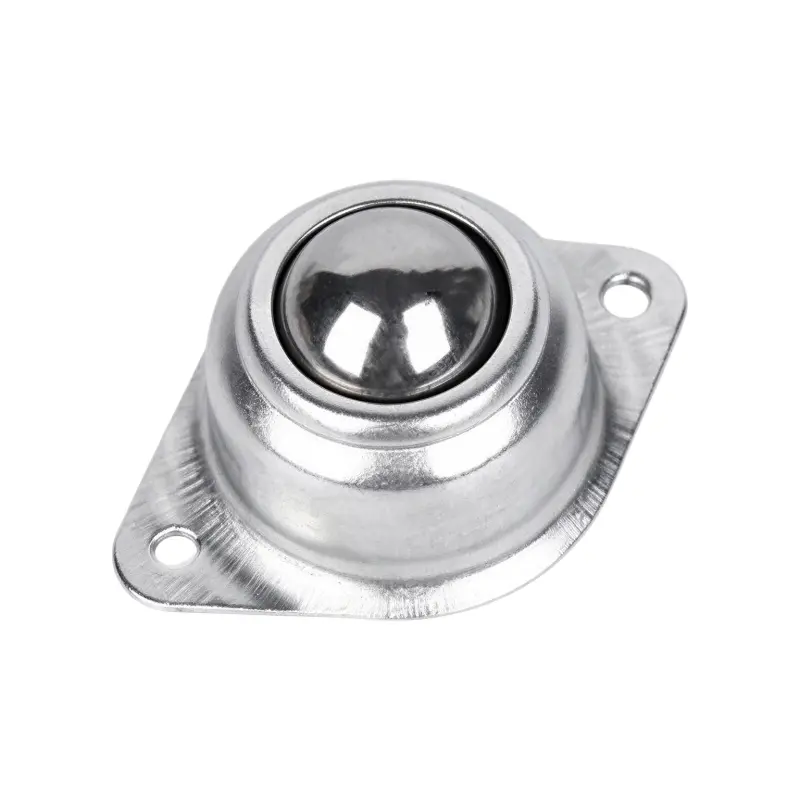
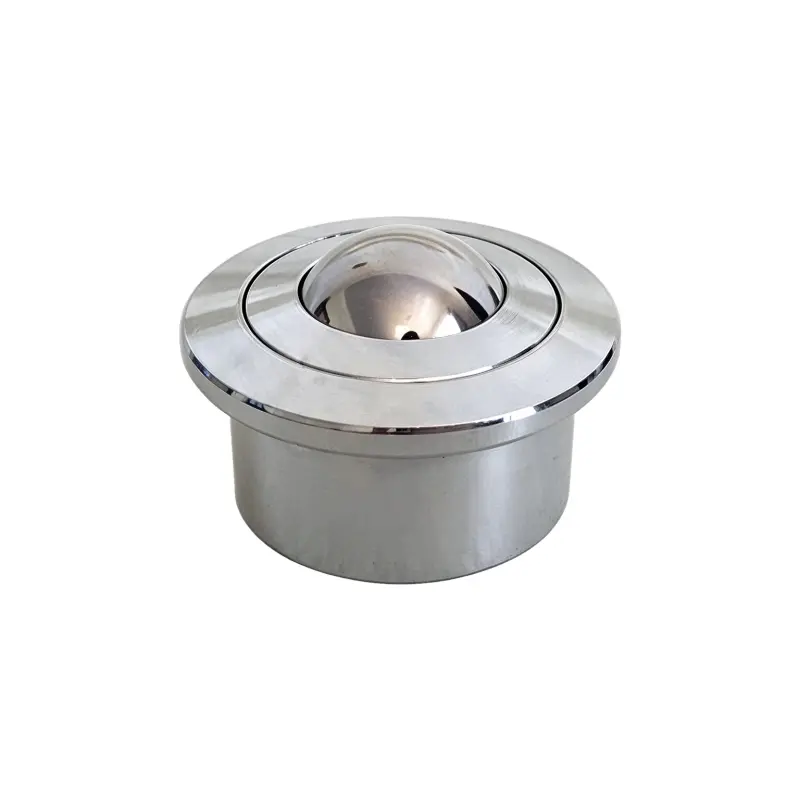
A Ball Transfer Unit - sometimes called a ball caster, ball transfer, or omnidirectional ball - is a mechanical component that consists of a large main ball supported by many smaller balls inside a housing. The large ball rotates freely in any direction, allowing a load resting on top of it to move omnidirectionally with very low friction.
The basic structure includes:
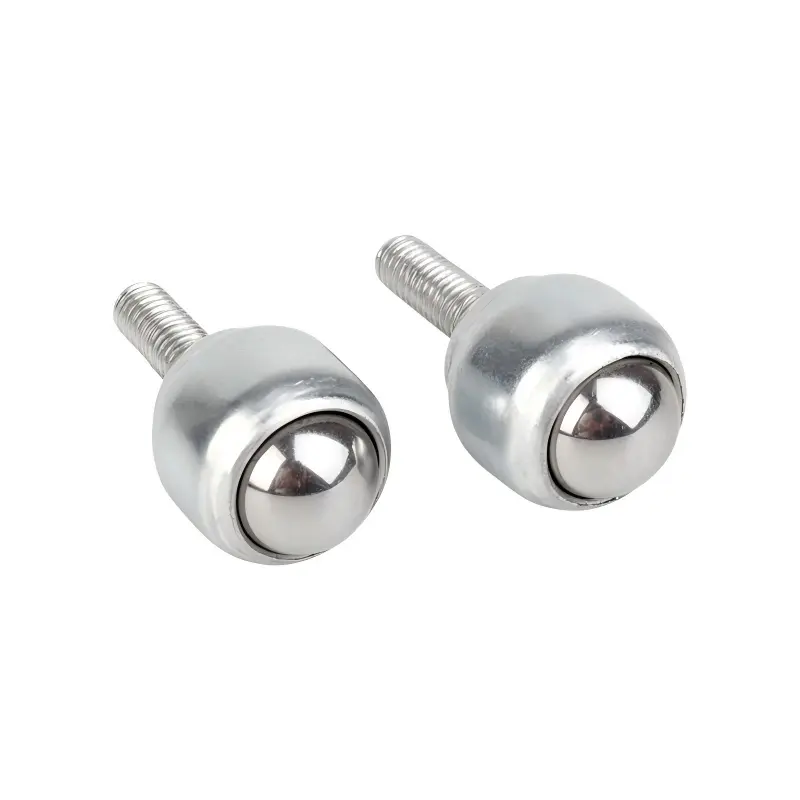
- Main ball (top ball): The large ball that contacts the load. It is typically made from carbon steel, stainless steel, nylon or POM, depending on the application.
- Support balls (small balls): A ring or bed of smaller balls beneath the main ball that allows it to rotate smoothly in any direction.
- Housing: The metal or plastic body that holds the balls and mounts to the conveyor or work surface.
- Cover or seal (optional): Some units include a cover or seal to keep dust and debris out of the ball chamber.
- Mounting feature: Stud, flange, threaded body, spring-loaded or recessed design for installation.
The key advantage of a Ball Transfer Unit is that it provides a nearly frictionless, multidirectional surface. Unlike a roller, which only allows movement perpendicular to its axis, a ball transfer allows movement in any direction. This makes it ideal for applications where loads need to be rotated, aligned, diverted or transferred between conveyor lines.
How a Ball Transfer Unit Works
The working principle is simple but effective. The main ball sits on a bed of smaller balls that act like a low-friction bearing. When a load is placed on the main ball, the ball rotates freely in response to any horizontal force. Because the contact between the main ball and the support balls is rolling rather than sliding, friction is very low. The result is that a heavy load can be moved with minimal effort, and it can be moved in any direction without repositioning the unit.
The support balls are typically arranged in a circle or a full bed, depending on the design. The housing keeps the balls in place and transfers the load to the mounting surface. Lubrication and sealing affect smoothness and service life. In dirty or wet environments, sealed units or stainless steel construction may be required to prevent contamination and corrosion.
One important characteristic of Ball Transfer Units is that they are usually installed in arrays or grids on a conveyor table or work surface. A single unit cannot support a large load on its own; instead, multiple units share the load and provide a continuous support surface. The spacing between units depends on the load, the size of the load and the rigidity of the load's bottom surface.
Types of Ball Transfer Units
Ball Transfer Units come in several configurations, each suited to different mounting and application requirements.
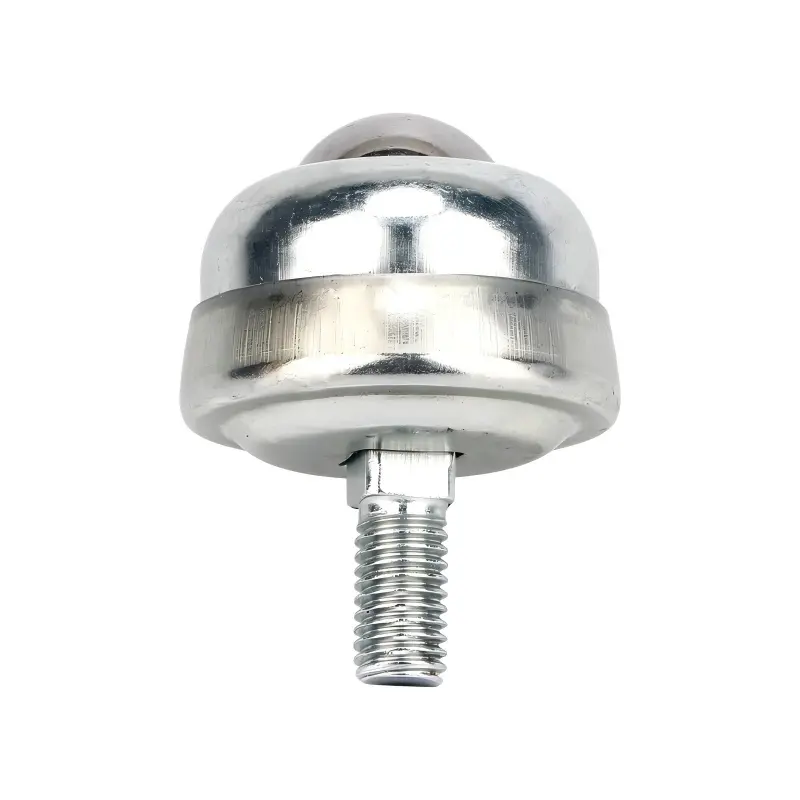
Stud-mounted units have a threaded stud that mounts through a hole in the conveyor surface and is secured with a nut. They are easy to install and replace, and they are common in conveyor tables and assembly stations.
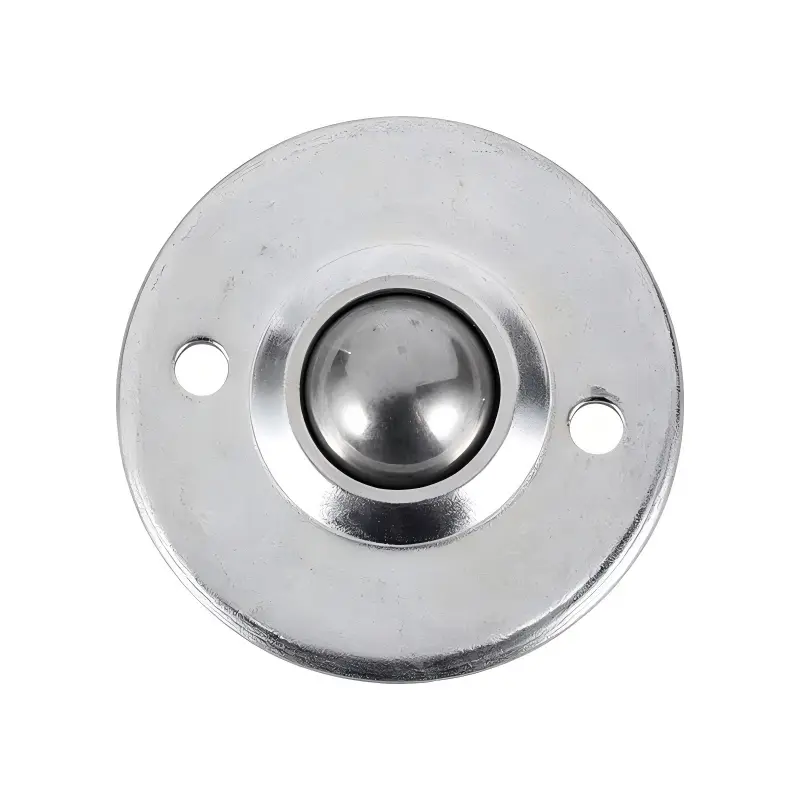
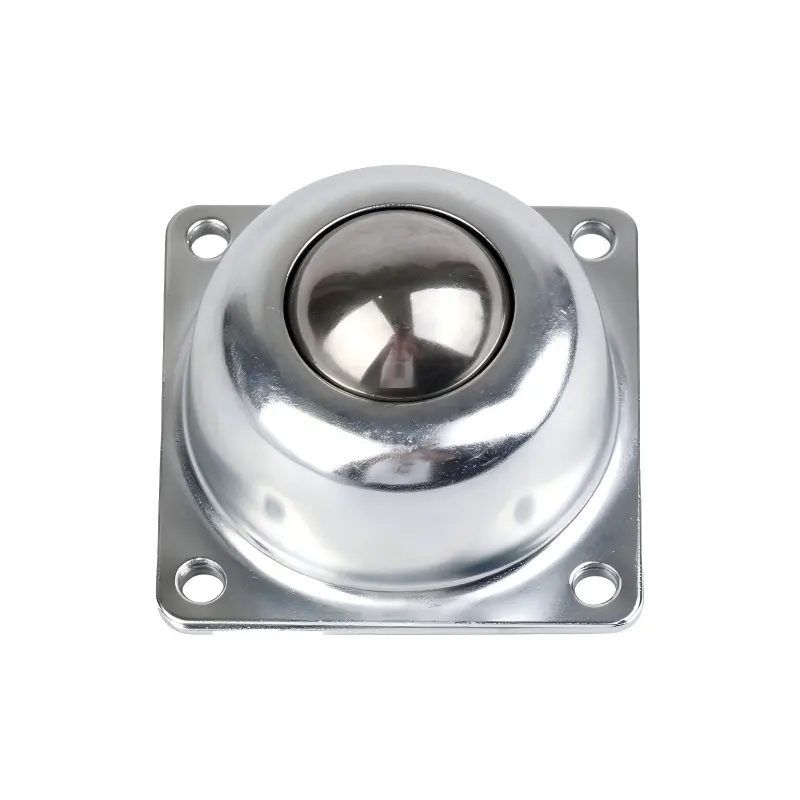
Flange-mounted units have a flange that sits on top of the surface or mounts from below. They provide a larger bearing area and are suitable for heavier loads or thinner surfaces.
Threaded-body units have a threaded cylindrical body that screws into a tapped hole. They offer a clean, flush installation and are common in machine tables and precision applications.
Spring-loaded units allow the main ball to retract under load, which can be useful in applications where the load needs to be lowered onto a surface or where a flush surface is required when not in use.
Recessed or drop-in units are designed to sit flush with the surface, often used in conveyor transitions and areas where a smooth surface is important.
Heavy-duty units are designed for high load capacity and are often larger in diameter with reinforced housings and high-strength balls. They are used in heavy material handling, steel mills, mining and large-scale logistics.
Corrosion-resistant units use stainless steel balls and housings for food processing, pharmaceutical, marine and chemical environments.
Low-profile units are designed for applications where vertical space is limited, such as conveyor transitions and tight installations.
The choice of type depends on the load, the mounting surface, the available space, the environment and the maintenance requirements.
Ball Materials and Their Applications
The ball material has a major effect on performance, load capacity, noise, corrosion resistance and product protection.
Carbon steel balls are the most common and economical choice. They offer high load capacity and good wear resistance. They are suitable for general industrial applications in dry environments. However, they can rust in humid or corrosive conditions and may damage delicate products if not carefully finished.
Stainless steel balls offer excellent corrosion resistance and are suitable for food processing, pharmaceutical, chemical, marine and washdown environments. They are more expensive than carbon steel but reduce maintenance and replacement costs in aggressive environments.
Nylon balls are lightweight, quiet and non-marking. They are suitable for light-duty applications, cleanrooms, electronics handling and situations where product protection is important. They have lower load capacity than steel balls.
POM (acetal) balls offer good mechanical strength, low friction and chemical resistance. They are often used in food processing, packaging and light-to-medium-duty material handling.
PU-coated or specialty balls may be used for specific applications requiring grip, noise reduction or product protection.
The choice of ball material should match the load, the environment and the product. For heavy loads in a dry factory, carbon steel is often the best value. For food processing or washdown, stainless steel is essential. For delicate products or cleanrooms, nylon or POM may be preferred.
Load Capacity and Selection
Load capacity is one of the most important selection criteria. A Ball Transfer Unit must be able to support the load placed on it, with an appropriate safety factor.
Load capacity depends on the ball diameter, ball material, housing design and the number of support balls. Larger units generally have higher load capacity. Heavy-duty units may be rated for hundreds or thousands of kilograms.
When designing a Ball Transfer Unit array, consider the following:
- Total load: The weight of the product plus any pallet, fixture or container.
- Number of units: The load is shared among the units in contact with the load. Uneven floors or uneven loads may cause some units to carry more than others.
- Load distribution: The load should be distributed across the units. A rigid load bottom helps ensure even contact.
- Safety factor: Apply a safety factor to account for dynamic loads, impact, uneven loading and wear. A common approach is to design for a capacity higher than the expected maximum load.
- Spacing: The spacing between units should be small enough to support the load without deflection. The load bottom must be strong enough to bridge the gaps between units.
A practical formula often used in the industry is to calculate the load per unit as the total weight divided by the number of units minus one, to account for uneven contact. The exact approach depends on the application and the load rigidity.
Applications of Ball Transfer Units
Ball Transfer Units are used in a wide range of industries and applications. Common examples include:
Conveyor systems: Ball transfer tables and conveyor transitions use arrays of units to allow loads to move smoothly, change direction, or transfer between conveyor lines. They are especially useful at intersections, turns and transfer points.
Assembly stations: Operators can rotate, position and align heavy components with minimal effort. This improves ergonomics and reduces fatigue.
Logistics and warehousing: Ball transfer units are used in sorting systems, packing stations and loading areas where loads need to be moved in multiple directions.
Food processing: Stainless steel units are used in hygienic environments where corrosion resistance and cleanability are important.
Automotive: Ball transfer units are used in assembly lines, engine and transmission handling, and parts transfer.
Aerospace: Used in assembly jigs, tooling and component handling where precision and smooth movement are required.
Medical and laboratory: Used in equipment handling and cleanroom applications where non-marking and low-noise operation are important.
Metalworking and fabrication: Used in worktables and transfer systems for heavy steel plates and components.
In each application, the value of the Ball Transfer Unit comes from its ability to provide omnidirectional movement with low friction, reducing manual effort and improving workflow.
Common Buyer Questions About Ball Transfer Units
International buyers often ask the same set of questions when sourcing Ball Transfer Units. Here are the answers.
Are you a manufacturer or a trading company?
AstraRoll is a manufacturer. We produce Ball Transfer Units and industrial roller wheels in our own factory, with in-house machining, assembly and inspection. This allows us to support OEM projects, wholesale orders and custom requirements.
What specifications do you offer?
We offer multiple configurations, including stud-mounted, flange-mounted, threaded-body, spring-loaded and heavy-duty units, in carbon steel, stainless steel, nylon and POM ball materials. Selection depends on load, environment, mounting and product requirements.
Can you customize units?
Yes. We support customization of dimensions, ball material, housing material, mounting structure, load rating and surface treatment. We can work from drawings, samples or application requirements.
What is the MOQ and lead time?
MOQ depends on whether the item is standard or custom. Standard units can be supplied in flexible quantities, while custom units may require a minimum production batch. Lead time is confirmed at quotation based on quantity, material availability and customization.
How do you control quality?
We inspect incoming materials, monitor in-process production and inspect finished units before shipment. Critical checks include ball roundness, rotation smoothness, load capacity, housing dimensions and surface finish. Inspection reports and material certificates can be provided on request.
What are the payment and shipping terms?
We support common international payment terms such as T/T and can discuss terms for long-term partners. We arrange express, air or sea freight depending on order size and urgency, and provide export packaging and documentation.
These questions reflect the practical concerns of buyers: supplier reliability, specification fit, customization, quality and logistics. A manufacturer that can answer them clearly and provide evidence is a safer partner.
Installation and Maintenance
Proper installation and maintenance extend the life of Ball Transfer Units.
Installation: Ensure the mounting surface is flat and rigid. Align units so that the main balls are at the same height. Use the correct mounting method for the unit type. For arrays, space units according to the load and the rigidity of the load bottom.
Maintenance: Keep the balls clean and free from debris. In dirty environments, use sealed units or clean the units regularly. Check for smooth rotation and replace units that become rough, noisy or seized. Lubricate according to the manufacturer's recommendations, if applicable.
Replacement: Replace units when the ball is worn, the housing is damaged, or rotation becomes rough. Worn units increase friction and can damage the load or the surface.
Ball Transfer Units are a simple but highly effective solution for omnidirectional material handling. They reduce friction, improve ergonomics and enable smooth movement in any direction. Selecting the right unit depends on load, environment, ball material, mounting and maintenance requirements.
For buyers, the key is to work with a manufacturer that can provide the right specification, customization, quality documentation and export support. AstraRoll manufactures Ball Transfer Units and industrial roller wheels with in-house production and inspection, and supports OEM and wholesale orders. If you are evaluating Ball Transfer Units for your conveyor, assembly or logistics application, contact us with your load, environment and mounting requirements to discuss the right solution.