
Phone: +86 15398058207
E-mail: sales@astraroll.com
Add: Room 603, Building C, Huixin Center, No.1 Zhangba Road, Yanta District, Xi'an, Shaanxi, China
How to Choose the Right Industrial Rollers for Your Conveyor System
Choosing the right industrial rollers for a conveyor system is one of the most important decisions in material handling engineering. A conveyor is only as reliable as the rollers that support, guide and drive it. The wrong roller specification can lead to belt mistracking, excessive vibration, premature bearing failure, product damage and unplanned downtime. The right specification, by contrast, can improve throughput, reduce energy consumption and extend the service life of the entire conveyor line.
At AstraRoll, we have spent more than 16 years engineering precision rollers for logistics, manufacturing, packaging, food processing, textile, electronics and heavy-duty bulk handling applications. This guide walks through the key selection criteria—load, speed, environment, material, diameter, shaft, bearing, surface finish and customization - so you can specify the right industrial rollers for your conveyor system with confidence.
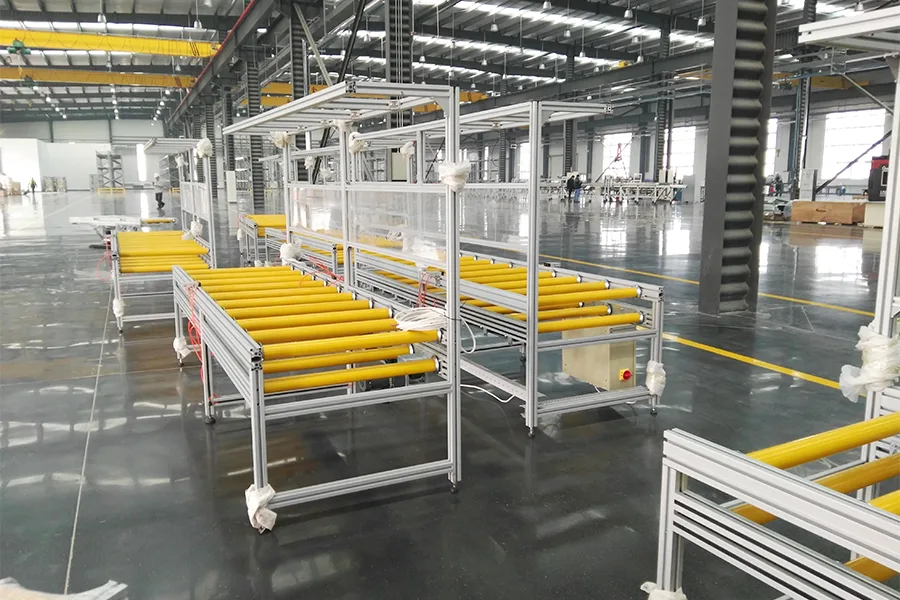
1. Start with the Conveyor Duty: Load, Speed and Orientation
Before choosing a roller type, define the conveyor's duty. Three parameters matter most: load per roller, belt speed and roller orientation.
Load per roller determines the required wall thickness, shaft diameter and bearing capacity. For light logistics lines handling cartons, a standard conveyor roller with a thin-walled steel tube and small shaft may be sufficient. For mining, ports or heavy bulk material handling, you need thicker walls, larger shafts and heavy-duty bearings. A useful rule is to calculate the maximum load per roller under the worst-case condition - full belt loading, impact at transfer points and uneven material distribution - and then apply a safety factor of at least 1.5 to 2.0.
Belt speed affects bearing selection, dynamic balancing requirements and noise. At low speeds, standard bearings and static balancing are usually acceptable. At high speeds, centrifugal force amplifies any imbalance, causing vibration, chatter marks and bearing wear. In these cases, dynamic balancing to ISO 21940 G2.5 or G1.0 becomes essential. High-speed lines also benefit from precision-machined roller shells with tight concentricity.
Roller orientation determines whether you need idler rollers, return rollers, impact rollers or drive rollers. Carrying-side rollers support the loaded belt; return-side rollers support the empty belt; impact rollers absorb shock at loading points; and drive drum pulleys transmit torque. Each has a different design priority.
2. Choose the Roller Type: Idler, Drive, Impact or Special Purpose
Conveyor systems use several roller families, and selecting the right family is the first major decision.
Idler rollers are non-powered supporting components. Their job is to hold up the belt and material, reduce friction, maintain belt tracking and prevent sagging. Idler rollers are available as flat idlers, troughing idlers, return idlers, impact idlers and self-aligning idlers. Troughing idlers form the belt into a trough to contain bulk material; return idlers support the empty return strand; impact idlers use shock-absorbing designs at transfer points; and self-aligning idlers correct belt deviation.
Drive drum pulleys are the power transmission components. They transfer torque from the drive unit to the belt and must maintain belt alignment under high tension. A drive drum pulley typically requires a robust shell, precision machining, proper lagging and dynamic balancing. Drive pulleys are selected based on torque, belt width, wrap angle and tension.
Special-purpose rollers include expander rollers for web spreading, brush rollers for cleaning, air shafts for winding and unwinding, and tungsten carbide rollers for extreme wear resistance. These are used in web handling, printing, packaging and converting rather than bulk conveying.
For most conveyor projects, the core selection is between idler rollers and drive pulleys, with impact rollers added at loading points and self-aligning rollers added on long or misalignment-prone lines.
3. Select the Roller Material Based on Environment and Load
Material selection is where many conveyor projects succeed or fail. The roller shell material affects load capacity, corrosion resistance, weight, noise and product compatibility.
Steel rollers are the workhorse of general industrial conveying. They offer high strength, good rigidity and cost efficiency. Steel rollers are suitable for heavy loads, high tension and general manufacturing environments. Carbon steel rollers are a cost-effective option for dry, non-corrosive applications. They can be painted, galvanized or coated for moderate protection.
Stainless steel rollers are the choice for corrosive, humid, washdown or hygiene-sensitive environments. Stainless steel rollers resist rust and chemical attack, making them suitable for food processing, pharmaceutical production, chemical plants and outdoor or coastal installations. They cost more than carbon steel but reduce maintenance and replacement costs in aggressive environments.
Aluminum alloy rollers are lightweight and corrosion-resistant. Aluminum alloy rollers reduce inertia, which is valuable on high-speed lines, low-noise applications and cleanroom or light-duty conveyors. They are also easier to handle during installation and maintenance.
Rubber rollers use a rubber cover over a steel or aluminum core. The rubber surface provides high friction, shock absorption and product protection. Rubber rollers are ideal for inclined conveyors, fragile products, printing and packaging nip rollers, and applications where slip resistance or gentle handling is required.
Silicone rollers offer high-temperature resistance, non-stick properties and good release characteristics. They are used in food processing, packaging, textile and high-heat applications where rubber would degrade.
PU rollers provide excellent wear resistance, load capacity and cut resistance. Polyurethane rollers are often used in demanding conveying, guiding and industrial machinery applications.
Carbon fiber rollers are lightweight and high-strength, with low inertia and excellent dimensional stability. They are used in high-speed web handling, printing and specialized automation where weight reduction and precision matter.
A practical approach is to shortlist two or three materials, then compare them on load capacity, corrosion resistance, weight, product contact, noise and total cost of ownership.
4. Specify Diameter, Wall Thickness and Shaft Correctly
Roller diameter affects belt support, rolling resistance, load capacity and the height of the conveyor line. Larger diameters reduce rolling resistance and bearing speed, but increase weight and cost. Smaller diameters save space and weight but may deflect under load.
Wall thickness and shaft diameter determine stiffness. For wide conveyors and heavy loads, the roller must resist bending. A roller that deflects will cause belt mistracking, uneven wear and poor material support. In wide-web and high-tension applications, internal reinforcement and heavy-wall tubes help maintain a straight profile under load.
Shaft design is equally important. The shaft must transmit load to the bearings and frame without excessive deflection. Key considerations include shaft material, diameter, keyway or flat, bearing fit, mounting method and access for maintenance. For drive pulleys, shaft torque capacity and fatigue strength are critical.
AstraRoll supports full customization of diameter, length, shaft size, wall thickness and installation structure, so rollers can be matched to the conveyor dimensions and load profile without adapters or modification.
5. Choose the Right Bearing and Sealing System
Bearings are the most common failure point in conveyor rollers. Bearing selection depends on load, speed, temperature, contamination and maintenance access.
For general indoor conveying, standard deep-groove ball bearings with sealed covers are common. For dusty, wet or outdoor environments, sealed or shielded bearings with effective labyrinth seals are essential. Sealed bearing structures block dust, moisture, sand and debris, protecting the bearing interior and extending service life.
For heavy loads, tapered roller bearings or larger ball bearings may be required. For high speeds, precision bearings with low runout and proper lubrication are important. For food processing and washdown environments, stainless steel bearings or food-grade lubricants may be needed.
Sealing is often overlooked. A high-quality bearing will fail quickly if contamination enters. Look for multiple sealing stages, tight tolerances at the seal interface and corrosion-resistant seal materials.
6. Match Surface Finish and Covering to the Product
The roller surface is the interface between the conveyor and the product. Surface finish affects friction, product protection, cleaning and wear.
Smooth steel surfaces are suitable for general conveying and low-friction applications. Knurled or grooved surfaces improve grip and can help with air venting or anti-slippage. Rubber or PU covers provide high friction and product protection. Silicone covers offer release and high-temperature performance. Hard chrome plating improves wear resistance and corrosion resistance. Tungsten carbide coatings provide extreme wear resistance for high-contact or abrasive applications.
For printing, packaging and web handling, surface finish also affects web tension, air entrainment and mark prevention. A precision-ground surface with controlled roughness is often required.
7. Consider Dynamic Balancing for High-Speed Lines
Dynamic balancing is essential for high-speed rollers. At high RPM, even a small imbalance creates centrifugal force that causes vibration, noise, bearing load and surface chatter. Balancing grades such as ISO 21940 G2.5 or G1.0 define acceptable residual imbalance.
For low-speed conveyors, static balancing may be sufficient. For high-speed web handling, printing, coating and lamination lines, dynamic balancing is critical. A balanced roller runs quieter, lasts longer and produces better product quality.
8. Plan for Maintenance and Replacement
Even the best roller will eventually need maintenance or replacement. Design for access: choose mounting methods that allow roller removal without dismantling the entire conveyor. Specify bearings and seals that can be inspected and replaced. Keep spare rollers or bearing kits for critical lines.
Regular maintenance includes inspection for wear, lubrication of bearings where applicable, cleaning of debris and checking for belt mistracking or vibration. A preventive maintenance schedule reduces unplanned downtime and extends roller life.
9. Validate with Samples and Performance Testing
Before committing to a full production order, validate the roller design with samples. Test the roller under representative load, speed and environmental conditions. Check concentricity, vibration, noise, bearing temperature, surface wear and belt tracking.
AstraRoll provides sample testing, drawing review and selection support. Our engineering team can review your conveyor layout, load requirements and operating environment, then recommend the optimal roller type, material, bearing and surface finish.
10. Use a Supplier with Full Manufacturing Control
Finally, choose a supplier with full manufacturing control. Vertical integration - from raw material cutting to CNC turning, milling, dynamic balancing, surface coating and final inspection - ensures consistent quality and protects your proprietary designs.
AstraRoll controls the complete manufacturing process in-house. Our quality control lab uses precision metrology instruments to inspect dimensional accuracy, concentricity and surface finish. Every roller is inspected before dispatch, and our team provides OEM/ODM engineering support from CAD drawing to mass production.
Choosing the right industrial rollers for your conveyor system requires a structured approach: define the duty, select the roller type, choose the material, specify diameter and shaft, select bearings and seals, match the surface finish, consider dynamic balancing, plan for maintenance, validate with samples and choose a supplier with full manufacturing control.
If you are unsure which roller is right for your application, start with the load, speed and environment. Then shortlist materials and roller types, and validate with a sample. With the right specification, your conveyor will run smoother, last longer and cost less to maintain.
For personalized selection support, contact AstraRoll or explore our industrial roller catalog to find the right roller for your conveyor system.
- How to Choose the Right Industrial Rollers for Your Conveyor System
- Slip Shaft vs Air Shaft: The Two Must-Know Rewind Shafts for Slitting
- Air Shafts – The Unsung Backbone of Automated Web Production Lines
- Air Shafts: How Pneumatic Expanding Shafts Optimize Your Winding
- How to Choose Reliable Heavy‑Duty Brush Roller Manufacturer
- What is Tungsten Carbide Rolls?
- Why Diamond Grooving on Rubber Rollers Improves Traction and Roller Life
- What Is a Diamond-Embossed Aluminum Roller?