
Phone: +86 15398058207
E-mail: sales@astraroll.com
Add: Room 603, Building C, Huixin Center, No.1 Zhangba Road, Yanta District, Xi'an, Shaanxi, China
Slip Shaft vs Air Shaft: The Two Must-Know Rewind Shafts for Slitting
For slitting converters, two shafts are unavoidable: slip shafts and air shafts. The quality of your rewound rolls and final yield rate heavily depend on your rewind shaft selection. Many new operators mistakenly believe they are just different names for the same part and can be swapped freely. In fact, they work on completely different principles.
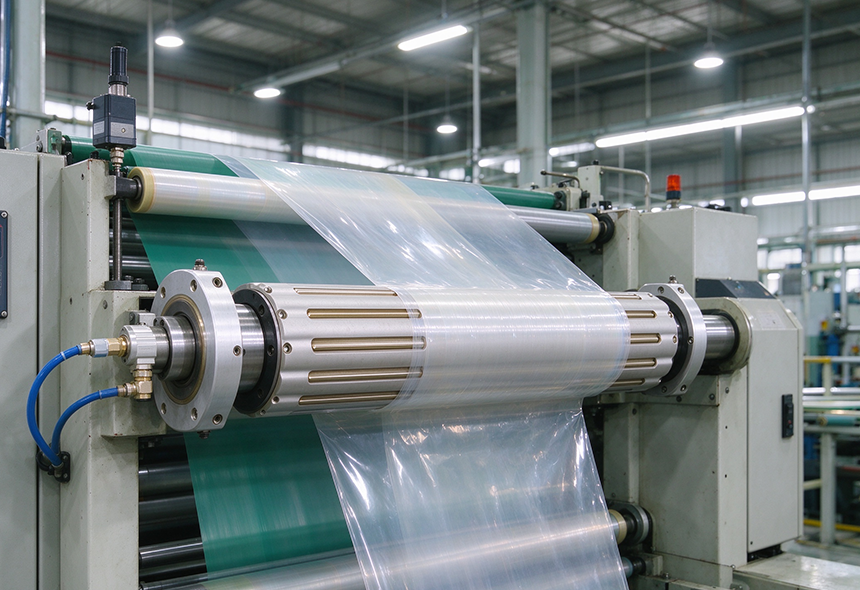
How They Work, In Simple Terms
✅ Air Shaft: Rigid Synchronous Drive An air shaft runs as one rigid unit. After inflation, the key bars or tiles expand outward to lock the paper cores firmly to the shaft. All cores rotate at the exact same speed as the shaft with zero relative slip. One unified tension applies to the whole shaft. In short: Synchronized drive, one tension for all rolls.
✅ Slip Shaft: Independent Torque Control for Each Roll A slip shaft is assembled with multiple individual slip rings equipped with friction components. The shaft core transmits power, while each slip ring works independently. Once you set the base torque via air pressure, the slip ring for the roll with larger resistance or growing roll diameter slips slightly automatically to compensate for speed differences. Every roll maintains its own stable tension without interfering with others. In short: Independent tension control, precise torque distribution for every single roll.
Pros & Cons Comparison
👉 Air Shaft Advantages
- Simple structure and low procurement cost
- Cores are locked tightly after inflation, resistant to core shifting and side wandering
- Low maintenance, reliable performance, easy inflation/deflation and fast loading/unloading
- High load capacity, ideal for thick materials and large-diameter rolls for single or low-count slitting
Limitations All cores spin at the same speed with no individual tension adjustment. When slitting multiple lanes, mixed widths or materials with thickness tolerance, some rolls get over-tensioned and stretched while others remain loose. This leads to uneven roll faces, wrinkles and edge curling. Scrap rates rise sharply for thin films and low-tension materials.
Best Applications Single rewind, slitting of 2–3 lanes, thick paper, heavy film, nonwovens. Suitable for projects with moderate roll surface requirements and limited budgets, and materials with consistent thickness and relaxed tension tolerance.
👉 Slip Shaft Advantages
- Perfect for multi-lane narrow slitting. Consistent tightness and neat roll faces across all lanes
- Automatically compensates for diameter variation and material thickness deviation. Greatly improves yield for stretch-sensitive thin materials such as PET, aluminum foil, copper foil and battery separators
- Built for high-speed precision slitting; widely adopted in lithium battery, optical film and premium adhesive tape industries
- Balanced tension from inner core to outer layer, reducing roll bursting and wrinkling during downstream rewinding and die-cutting
Limitations
- Much higher cost, several times the price of standard air shafts
- Complex construction; friction pads are consumable parts requiring regular inspection and replacement
- Steeper learning curve. Improper air pressure and torque setting will cause unwanted slipping or poor winding
- Some designs offer limited core positioning. Core drift may occur, so disc stoppers are usually required
Best Applications Multi-lane narrow slitting; ultra-thin films, copper foil, aluminum foil, lithium electrode sheets, protective films and precision adhesive tapes. For materials prone to stretching and strict requirements on roll face quality and tension consistency.
Selection Reference Table
| Item | Air Shaft | Slip Shaft |
|---|---|---|
| Tension Control | Unified tension for the whole shaft, no single-roll adjustment | Independent torque per slip ring, adaptive slip |
| Slitting Lanes | Single lane or low lane count | Multiple lanes, mixed narrow widths |
| Rewind Quality | Big tightness difference if material thickness varies | Uniform tightness, flat roll face |
| Cost | Low | High |
| Maintenance | Minimal | Moderate to high; friction parts need periodic replacement |
| Typical Materials | Thick paper, heavy film, nonwoven, general rewinding | PET, BOPP, copper foil, aluminum foil, separator, adhesive label, optical film |
Selection Guidelines
- If you mainly run single rewind or 2–3 lanes of thick material, choose air shafts for outstanding cost performance and stable operation.
- If you regularly slit 5+ narrow lanes, process films, metal foils or lithium battery materials and prioritize low waste, slip shafts are your go-to solution.
- Do not assume slip shafts are always better. Air shafts deliver more stable performance for heavy, thick materials with high tension demand, and offer superior grip for slippery substrates.
- Hybrid line layouts are common: air shaft for the first rewind and slip shaft for the second rewind, balancing budget and precision.
- A slip shaft is not a set-and-forget component. Adjust air pressure according to material gauge and running speed. Too much pressure eliminates slip and makes it act like an air shaft; too little pressure causes continuous slipping and loose winding.
Final Takeaway
An air shaft locks cores and turns them together. A slip shaft controls tension for every roll separately. There is no universally superior shaft — only the right solution matched to your product.
Published by AstraRoll — Professional Roller & Shaft Exporter
- Slip Shaft vs Air Shaft: The Two Must-Know Rewind Shafts for Slitting
- Air Shafts – The Unsung Backbone of Automated Web Production Lines
- Air Shafts: How Pneumatic Expanding Shafts Optimize Your Winding
- How to Choose Reliable Heavy‑Duty Brush Roller Manufacturer
- What is Tungsten Carbide Rolls?
- Why Diamond Grooving on Rubber Rollers Improves Traction and Roller Life
- What Is a Diamond-Embossed Aluminum Roller?
- How Long Do Rubber Rollers Last?