
Phone: +86 15398058207
E-mail: sales@astraroll.com
Add: Room 603, Building C, Huixin Center, No.1 Zhangba Road, Yanta District, Xi'an, Shaanxi, China
Industrial Rollers Material Guide
Material selection is one of the most consequential decisions when specifying industrial rollers. The roller shell material determines load capacity, corrosion resistance, grip, noise, weight, product compatibility, maintenance requirements and total cost of ownership. A roller made from the wrong material can fail prematurely, damage products or drive unnecessary downtime. A roller made from the right material can run reliably for years with minimal maintenance.
At AstraRoll, we manufacture precision rollers in rubber, silicone, steel, stainless steel, aluminum alloy, carbon steel, carbon fiber and PU. Each material has distinct advantages and limitations. This guide compares the most common industrial roller materials—rubber, silicone, steel and stainless steel - and also covers aluminum alloy, carbon fiber, carbon steel and PU so you can make an informed selection for your application.
Whether you are specifying rollers for a conveyor system, printing press, packaging line, food processing plant or high-speed web handling machine, this material guide will help you match the material to the duty.
Why Roller Material Matters
Industrial rollers are not generic components. They are engineered mechanical parts that interact with the belt, the product and the operating environment. The material affects several performance dimensions:
- Load capacity: Steel and stainless steel provide high strength and stiffness. Aluminum and carbon fiber reduce weight but may require larger diameters or wall thickness to achieve the same stiffness.
- Corrosion resistance: Stainless steel, aluminum alloy, carbon fiber and certain rubber compounds resist corrosion. Carbon steel requires coating or plating in humid or chemical environments.
- Grip and friction: Rubber, silicone and PU provide high friction. Steel and aluminum provide low friction unless textured or coated.
- Product protection: Rubber and silicone absorb shock and protect delicate surfaces. Hard materials can scratch or dent products if not carefully finished.
- Temperature resistance: Silicone excels at high temperatures. Rubber has temperature limits depending on the compound. Steel and stainless steel handle high temperatures well.
- Noise and vibration: Rubber and PU dampen noise and vibration. Hard materials transmit vibration unless dynamically balanced.
- Cleanability: Stainless steel and silicone are easier to clean in hygienic environments. Porous or worn rubber can harbor residue.
- Weight and inertia: Aluminum and carbon fiber reduce rotating mass, which improves acceleration and reduces energy consumption on high-speed lines.
A systematic comparison helps avoid over-specifying one property while neglecting another.
Rubber Rollers: Grip, Shock Absorption and Product Protection
Rubber rollers are among the most versatile industrial rollers. They use a rubber cover bonded to a steel or aluminum core. The rubber surface provides a high coefficient of friction, excellent shock absorption and reliable product protection.
Advantages of rubber rollers:
- High grip and slip resistance, ideal for inclined conveyors and material handling.
- Shock absorption protects fragile products such as glass, electronics and packaged goods.
- Noise and vibration reduction improves the working environment.
- Even pressure distribution makes rubber rollers suitable for nip rollers in printing and packaging.
- Available in natural rubber, NBR, silicone rubber, neoprene and EPDM for different chemical and temperature requirements.
Limitations of rubber rollers:
- Rubber has temperature limits. Standard rubber may degrade at high temperatures; silicone rubber is better for high-heat applications.
- Rubber can wear in abrasive environments, although wear-resistant compounds are available.
- Some rubber compounds may not be suitable for food contact unless food-grade materials are specified.
- Rubber rollers require proper bonding to prevent delamination under high pressure or frequent rotation.
Rubber rollers are widely used in printing, packaging, laminating, textile processing, conveyor systems and general material handling. For applications requiring grip, gentle handling and shock absorption, rubber rollers are often the first choice.
Silicone Rollers: High Temperature and Release Performance
Silicone rollers use silicone rubber as the covering material. Silicone offers excellent high-temperature resistance, weather resistance, non-stick properties and chemical inertness.
Advantages of silicone rollers:
- High-temperature resistance makes silicone suitable for hot processes, lamination, packaging and textile machinery.
- Non-stick and release properties prevent materials from adhering to the roller surface.
- Good flexibility and shock absorption.
- Resistant to aging, ozone and weathering.
- Available in food-grade formulations for food processing and packaging.
Limitations of silicone rollers:
- Silicone generally has lower tear strength and abrasion resistance than some rubber compounds or PU.
- It may be more expensive than standard rubber.
- It may not be suitable for high-load, high-friction applications where wear resistance is critical.
Silicone rollers are ideal for applications involving heat, sticky materials or release requirements. Typical uses include food processing, packaging, textile, printing and high-temperature conveying. For high-temperature and release-critical applications, silicone rollers provide performance that standard rubber cannot match.
Steel Rollers: Strength, Rigidity and Cost Efficiency
Steel rollers are the workhorse of industrial conveying. They offer high strength, good rigidity and cost efficiency. Steel rollers are typically made from carbon steel or stainless steel, with carbon steel being the more economical option.
Advantages of steel rollers:
- High load capacity and stiffness, suitable for heavy-duty conveying.
- Good dimensional stability under load.
- Cost-effective for general industrial applications.
- Can be machined to tight tolerances for precision applications.
- Can be coated, plated or painted for corrosion protection.
Limitations of steel rollers:
- Carbon steel is susceptible to rust in humid or corrosive environments unless properly coated.
- Steel is heavier than aluminum or carbon fiber, which increases inertia and handling effort.
- Hard steel surfaces can damage delicate products if not finished or covered properly.
Steel rollers are widely used in general conveying, manufacturing, logistics and heavy-duty material handling. For cost-sensitive, dry, indoor applications, carbon steel rollers are often the most practical choice.
Stainless Steel Rollers: Corrosion Resistance and Hygiene
Stainless steel rollers are the premium choice for corrosive, humid, washdown or hygiene-sensitive environments. The stainless steel surface resists rust, chemical attack and contamination.
Advantages of stainless steel rollers:
- Excellent corrosion resistance in humid, chemical, food and pharmaceutical environments.
- Easy to clean and suitable for washdown applications.
- Good strength and durability.
- Resistant to many chemicals and cleaning agents.
- Suitable for outdoor and coastal installations.
Limitations of stainless steel rollers:
- Higher material and machining cost than carbon steel.
- May be heavier than aluminum or carbon fiber.
- Not all stainless steel grades are suitable for all chemicals; grade selection matters.
Stainless steel rollers are essential in food processing, pharmaceutical production, chemical plants, marine environments and any application where corrosion resistance and hygiene are critical. Although the upfront cost is higher, stainless steel often reduces maintenance and replacement costs over the life of the equipment.
Aluminum Alloy Rollers: Lightweight and Corrosion-Resistant
Aluminum alloy rollers offer a combination of light weight, corrosion resistance and good machinability. They are often used where reducing rotating mass and improving acceleration is important.
Advantages of aluminum alloy rollers:
- Lightweight, reducing inertia and energy consumption.
- Good corrosion resistance compared with carbon steel.
- Easy to machine and available in complex profiles.
- Suitable for high-speed and low-noise applications.
- Can be anodized for additional surface protection.
Limitations of aluminum alloy rollers:
- Lower strength and stiffness than steel, so larger diameters or wall thickness may be required.
- Not suitable for extremely heavy loads without careful design.
- Can be more expensive than carbon steel.
Aluminum alloy rollers are used in cleanroom applications, light-duty conveyors, high-speed lines and automation where weight reduction matters. They are also a good choice when corrosion resistance is needed but stainless steel is over-specified.
Carbon Steel Rollers: Cost-Effective General Purpose
Carbon steel rollers are a subset of steel rollers and are widely used for general industrial conveying. They offer good strength at a lower cost than stainless steel.
Advantages of carbon steel rollers:
- Cost-effective for high-volume and general applications.
- Good strength and rigidity.
- Easy to machine, weld and coat.
- Suitable for dry, indoor environments.
Limitations of carbon steel rollers:
- Susceptible to rust without coating or plating.
- Not suitable for corrosive or washdown environments unless protected.
- Requires maintenance of protective coatings.
Custom carbon steel rollers are a practical choice for general manufacturing, logistics and conveyor systems where corrosion is not a major concern. With proper painting, galvanizing or plating, they can perform reliably in many industrial environments.
PU Rollers: Wear Resistance and Load Capacity
Polyurethane (PU) rollers combine a PU covering with a metal core. PU offers excellent wear resistance, load capacity, cut resistance and oil resistance.
Advantages of PU rollers:
- High wear resistance and load capacity.
- Good resistance to oils, greases and many chemicals.
- Can be formulated in different hardness levels.
- Excellent for high-friction drive and guide applications.
- Longer service life than many rubber compounds in abrasive conditions.
Limitations of PU rollers:
- PU may not perform well at high temperatures.
- Certain chemicals can attack PU; material compatibility must be checked.
- Higher cost than standard rubber in some cases.
PU rollers are used in demanding conveying, guiding, packaging and industrial machinery applications where wear resistance and load capacity are important.
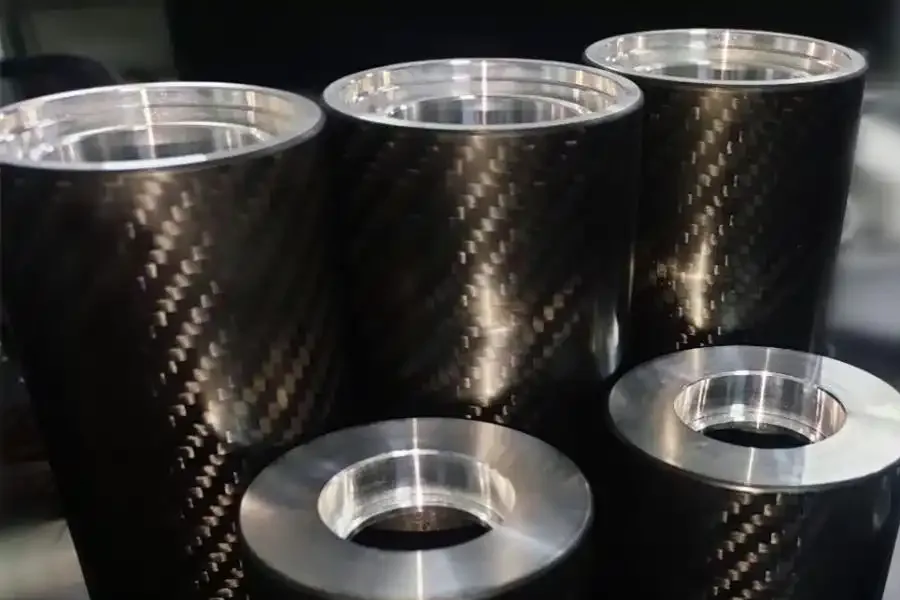
Carbon Fiber Rollers: Lightweight High-Performance
Carbon fiber rollers are high-performance components used in applications where weight reduction, high stiffness and low inertia are critical.
Advantages of carbon fiber rollers:
- Very lightweight with high stiffness-to-weight ratio.
- Low inertia, ideal for high-speed web handling and rapid acceleration.
- Excellent dimensional stability.
- Corrosion resistant.
- Can reduce vibration and improve dynamic performance.
Limitations of carbon fiber rollers:
- Higher cost than conventional materials.
- Requires specialized manufacturing and handling.
- Not suitable for every application; engineering support is important.
Custom carbon fiber rollers are used in printing, coating, lamination, film handling and high-speed automation where reducing rotating mass improves performance.
Direct Comparison: Rubber vs. Silicone vs. Steel vs. Stainless Steel
| Property | Rubber | Silicone | Steel | Stainless Steel |
|---|---|---|---|---|
| Grip / friction | High | Medium to high | Low (unless textured) | Low (unless textured) |
| Shock absorption | Excellent | Good | Low | Low |
| Load capacity | Medium | Low to medium | High | High |
| Corrosion resistance | Medium (depends on compound) | Good | Low (carbon steel) | Excellent |
| Temperature resistance | Medium | Excellent | High | High |
| Wear resistance | Good | Medium | Excellent | Excellent |
| Product protection | Excellent | Good | Poor unless covered | Poor unless covered |
| Cleanability | Medium | Good | Good | Excellent |
| Weight | Medium | Medium | High | High |
| Cost | Medium | Medium to high | Low to medium | High |
This comparison is a starting point. The final selection depends on the specific load, speed, environment, product and maintenance requirements.
How to Choose the Right Material
A practical selection process follows these steps:
- Define the environment. Is it dry, humid, corrosive, washdown, high-temperature or food-contact? This immediately narrows the material options.
- Define the load and speed. Heavy loads and high tension favor steel or stainless steel. High speed favors lightweight and dynamically balanced rollers such as aluminum or carbon fiber.
- Define the product contact requirement. Fragile or scratch-sensitive products favor rubber or silicone covers. Sticky products favor silicone or release coatings.
- Define the friction requirement. Inclined conveyors and nip rollers need high friction, favoring rubber or PU. Free-rolling conveyors favor low-friction steel or aluminum.
- Consider maintenance access. Stainless steel and silicone are easier to clean. Sealed bearings and corrosion-resistant materials reduce maintenance in harsh environments.
- Evaluate total cost of ownership. A higher upfront material cost may be justified by longer service life, lower maintenance and less downtime.
AstraRoll's engineering team can help compare materials based on your application data and recommend the optimal solution.
Surface Treatments and Coverings
Material selection is not only about the base material. Surface treatments and coverings can change performance significantly:
- Hard chrome plating improves wear and corrosion resistance on steel rollers.
- Tungsten carbide coatings provide extreme wear resistance for high-contact applications.
- Rubber and PU covers add grip, shock absorption and product protection.
- Silicone covers add high-temperature resistance and release properties.
- Anodizing improves corrosion resistance on aluminum rollers.
- Grooving and knurling improve grip and air venting.
AstraRoll offers a range of surface treatments and coverings to match the material to the application.
Quality Considerations for Each Material
Each material has specific quality risks:
- Rubber rollers: bonding quality, rubber hardness consistency, vulcanization control and surface finish.
- Silicone rollers: material purity, cure consistency, hardness and surface defects.
- Steel rollers: concentricity, wall thickness, weld quality, straightness and coating adhesion.
- Stainless steel rollers: material grade, corrosion resistance, surface finish and weld cleanliness.
- Aluminum rollers: alloy grade, straightness, anodizing quality and surface defects.
- Carbon fiber rollers: layup quality, balance, surface finish and dimensional stability.
AstraRoll inspects every roller for dimensional accuracy, concentricity and surface finish before dispatch. Our quality control lab uses precision metrology instruments to verify specifications.
The right industrial roller material depends on the application. Rubber offers grip, shock absorption and product protection. Silicone offers high-temperature resistance and release performance. Steel offers strength, rigidity and cost efficiency. Stainless steel offers corrosion resistance and hygiene. Aluminum alloy and carbon fiber reduce weight and inertia. PU offers wear resistance and load capacity. Carbon steel provides a cost-effective general-purpose option.
By defining the environment, load, speed, product contact and maintenance requirements, you can narrow the material options and select the roller that delivers the best performance and total cost of ownership.
For help comparing materials or specifying a custom roller, contact AstraRoll or explore our full range of industrial rollers to find the right solution for your application.
- Industrial Rollers Material Guide
- How to Choose the Right Industrial Rollers for Your Conveyor System
- Slip Shaft vs Air Shaft: The Two Must-Know Rewind Shafts for Slitting
- Air Shafts – The Unsung Backbone of Automated Web Production Lines
- Air Shafts: How Pneumatic Expanding Shafts Optimize Your Winding
- How to Choose Reliable Heavy‑Duty Brush Roller Manufacturer
- What is Tungsten Carbide Rolls?
- Why Diamond Grooving on Rubber Rollers Improves Traction and Roller Life