
Phone: +86 15398058207
E-mail: sales@astraroll.com
Add: Room 603 Building C, The Huixin Center, Zhangba One Road, Yanta Zone, Xi'an City, Shaanxi Province, China
How do Carbon Fiber Rollers Help Nonwoven Industries?
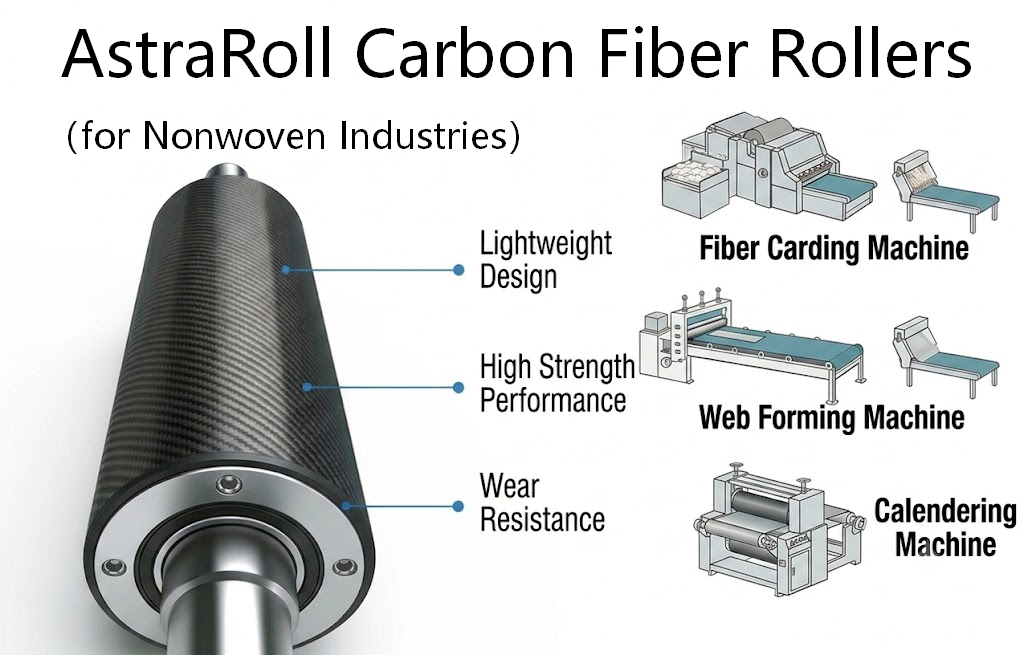
As nonwoven lines cross the 400m/minor even 600m/min thresholds, traditional steel and aluminum idler rollers run into a hard physical wall. They are simply too heavy. Their massive rotational inertia causes lagging, web scratches, and tension spikes that rip ultra-light nonwoven webs to shreds.
That is exactly why Tier-1 nonwoven equipment manufacturers and mill managers are ripping out metal rollers and upgrading to Carbon Fiber Idler Rollers.
Let's look at the real-world engineering reasons why carbon fiber is transforming nonwoven manufacturing, and why it is the ultimate insurance policy for your high-speed lines.
1. The Heavy Metal Problem in High-Speed Nonwovens
To understand why carbon fiber works so well, we first have to look at why aluminum and steel fail when lines speed up:
- The Inertia Lag (The Scrap Creator): When your nonwoven web changes speed or starts up, it has to physically force the idler rollers to spin. Because steel and aluminum are heavy, they resist spinning at first. This "inertia lag" causes the roller to slide underneath the ultra-light nonwoven web like a locked car tire on ice, instantly scratching your delicate material or tearing it apart.
- The "Banana Roll" Sag (Deflection): Nonwoven lines are getting wider—often spanning 3 to 5 meters. A long aluminum roller will naturally sag under its own weight. At high speeds, this micro-sag causes the roller to whip and vibrate, creating uneven web tension that leaves your final product wrinkled or structurally compromised.
2. The Carbon Fiber Advantage: Four Ways It Saves Your Production Line
Carbon fiber is a composite material that completely rewrites the rules of physics for web-handling engineers. Here is how it directly solves your daily shop-floor headaches:
Zero Inertia Lag = Blazing Line Speeds
Carbon fiber is roughly 70% lighter than steel and 30% lighter than aluminum, yet it is exponentially stronger. Because a carbon fiber roller has virtually zero rotational inertia, it takes next to no effort for a fragile, low-weight nonwoven web to spin it. When your line accelerates, the rollers adapt instantly. Slippage is completely eliminated, meaning zero surface scratches, zero web breaks, and a massive jump in your daily throughput.
Extreme Rigidity (Zero Sag Over Long Spans)
Carbon fiber has an incredible strength-to-weight ratio and a high modulus of elasticity. Even over massive 4-meter-wide spans, a carbon fiber roller experiences practically zero deflection (sag). The roller stays dead-straight, ensuring that your nonwoven web maintains perfectly uniform cross-machine tension from the left edge to the right edge.
Vibration Dampening at Critical Speeds
Every metal roller has a "critical speed"—a specific RPM where it begins to resonate and shake uncontrollably. Carbon fiber composites possess natural vibration-dampening properties. It absorbs high-frequency machine chatter like a sponge, allowing you to ramp up line speeds well past the limits of aluminum without causing web flutter or destroying your cantilever bearings.
Anti-Static and Dynamic Balance
Running synthetic fibers at extreme speeds creates a massive buildup of static electricity, which can cause nonwoven webs to cling to rollers and wrap around the shaft. Our carbon fiber rolls can be engineered with specialized conductive layers to safely dissipate static electricity to the ground.
3. Engineering Comparison: Metal vs. Carbon Fiber Rollers
To help your procurement and engineering teams make a data-backed decision, here is how the materials stack up under high-speed nonwoven duty cycles:
|
Performance |
Traditional Steel Rollers |
Premium Aluminum Rollers |
AstraRoll Carbon Fiber Rollers |
|
Weight & Rotational Inertia |
Extremely Heavy. High drag; prone to tearing light webs. |
Moderate. Better than steel, but slips at speeds over 300m/min. |
Ultra-Light. Virtually zero inertia; adapts instantly to speed changes. |
|
Max Span Without Sagging |
Poor. Heavy weight causes middle deflection over long widths. |
Fair. Suffers from micro-sagging on wide nonwoven machinery. |
Excellent. Zero deflection across massive 3 to 5-meter lines. |
|
Vibration Resonant Speed |
Low. Easily vibrates at standard operating frequencies. |
Medium. Prone to whipping and chattering at high RPMs. |
Incredibly High. Natural composite dampening kills vibration. |
|
Web Protection (Non-Scratch) |
Poor. Extreme drag causes high abrasive friction. |
Fair. Safe at slow speeds; causes friction marks on fast lines. |
Flawless. Instant synchronization eliminates web friction entirely. |
4. Why AstraRoll is the Trusted Carbon Fiber Partner for Nonwoven OEMs
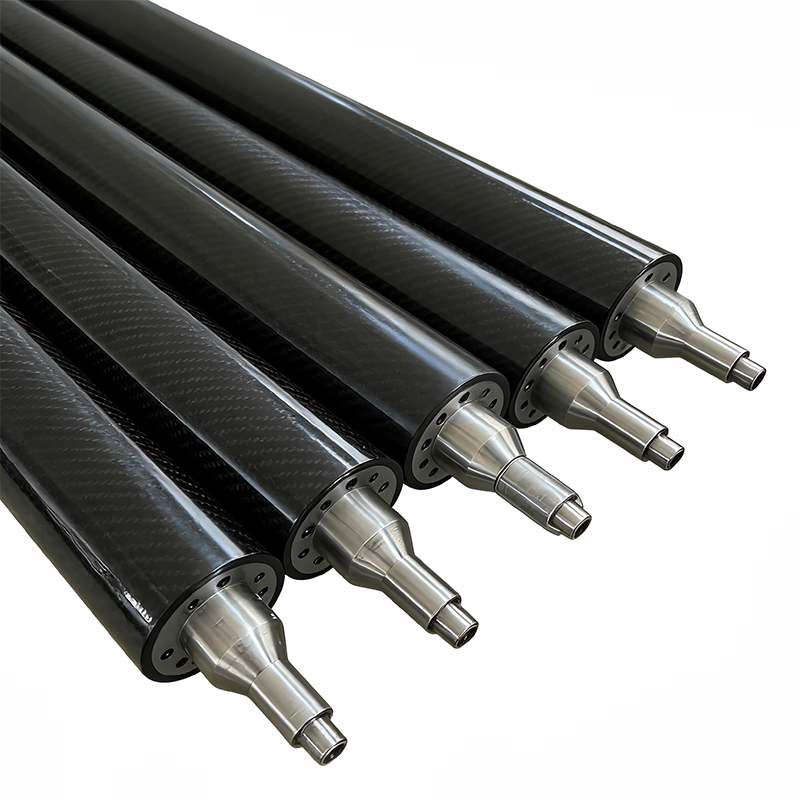
A carbon fiber roller is only as good as its geometric precision and bond integrity. You cannot just glue metal shaft ends into a composite tube and hope it survives a 24/7 factory environment.
At AstraRoll, we manufacture our high-performance composite rollers with zero-tolerance industrial rigor:
- Aerospace-Grade Filament Winding: We wind our carbon fiber tubes in-house, optimizing the carbon thread angles to match the exact bending and torsional loads of your nonwoven machinery.
- Patented Steel-to-Composite Journal Bonding: The biggest failure point in cheap rollers is the metal axle breaking away from the carbon sleeve under high torque. We use a proprietary multi-step mechanical and chemical interlocking process to ensure the journals and the composite shell become a single indestructible piece.
- Precision CNC Finishing & Dynamic Balancing: After curing, every roller is ground to micro-inch tolerances for outer diameter consistency and dynamically balanced to ISO G1.0 standards. This guarantees vibe-free running at speeds up to 800m/min.
Stop Fighting Tension Spikes—Upgrade Your Running Gear
In the modern nonwoven industry, sticking with heavy metal rollers on high-speed lines is like driving a sports car with the parking brake on. It limits your speed, creates endless piles of startup scrap, and forces your operators to babysit tension controls all day long.
Whether you are retrofitting an old carding machine, upgrading a spunbond line, or designing a brand-new high-speed slitter rewinder from scratch, we custom-engineer every roller to match your exact machine prints.
Ready to smash through your line's speed barrier? Explore our full material options on our dedicated AstraRoll Carbon Fiber Roller Tech Page or drop our engineering team a line today to secure a custom quote!
- The Silent Quality Drivers: How High-Precision Rollers Shape Release Film Perfor
- What Are the Benefits of Hard Anodized Aluminum Guide Rollers?
- Why High-End Manufacturing Cares So Much About Roller Surface Precision
- Why Your Heavy-Duty Conveyor Needs Garland Idler Rollers
- What are the differences and applications between anilox roller and embossing ro
- Why Teflon Coated Aluminum Rollers Are the Best Choice for Non-Stick Web Handlin
- How to Eliminate Static Accumulation and Defect Risks in High-Speed Battery Sepa
- What Are Hard Coated Rollers?