
Phone: +86 15398058207
E-mail: sales@astraroll.com
Add: Room 603 Building C, The Huixin Center, Zhangba One Road, Yanta Zone, Xi'an City, Shaanxi Province, China
Steel Rolls vs. Aluminum Rolls: How to Choose the Right Roller for Your Line
In industrial manufacturing and web handling, rollers are not background components. They guide, tension, press, cool, and transport material through packaging, printing, converting, film production, corrugated board, and many other processes. The roller material affects machine stability, product quality, energy consumption, and long-term maintenance cost.
Among the many material choices, steel and aluminum are two of the most common - and the choice between them is rarely about which one is "better." It is about which one fits the actual working conditions. At AstraRoll, we help customers specify rollers around load, speed, temperature, and precision requirements. Here is a practical comparison.
Steel Rolls: Built for Rigidity and Load Capacity
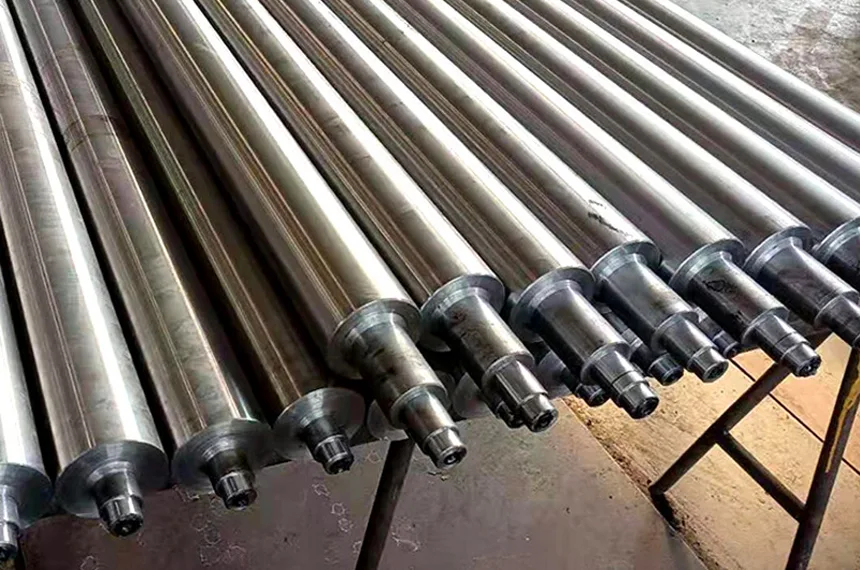
If steel rolls have one defining strength, it is load-bearing capability. Carbon steel and stainless steel offer high mechanical strength and stiffness, which makes them suitable for demanding industrial conditions.
Where steel rolls excel
1. Heavy-load and high-pressure applications
From stamping line conveyors in the automotive industry to heavy rolling equipment in metallurgy, steel rolls resist bending and deformation under large loads. Their high elastic modulus helps maintain dimensional stability through long heavy-duty cycles.
2. High-temperature processes
Steel rolls perform well in heat-intensive applications. Stainless steel rolls with PTFE or similar coatings can withstand temperatures above 200°C, making steel a natural choice for hot pressing, thermal lamination, and other high-temperature processes.
3. Surface durability
Through chrome plating, zinc plating, or other surface treatments, steel rolls can achieve high surface hardness, wear resistance, and corrosion resistance. This extends service life in harsh operating environments.
Where steel rolls may not be ideal
Steel is heavy. A steel roll has high rotational inertia, which means more torque and power are needed to accelerate, decelerate, or repeatedly start and stop the roll. In high-speed lines with frequent speed changes, this can increase energy use and reduce response speed.
Aluminum Rolls: Lightweight, Responsive, and Energy-Efficient
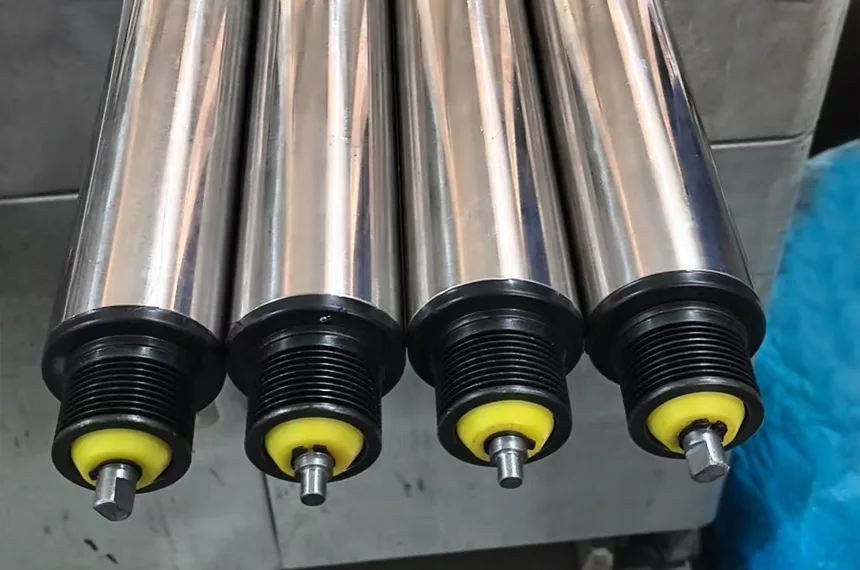
Aluminum rolls offer a different set of advantages. Their lighter weight and excellent thermal conductivity make them attractive for high-speed, precision, and energy-sensitive applications.
Where aluminum rolls excel
1. Lower rotational inertia and faster response
Aluminum has roughly one-third the density of steel. At the same roll size, an aluminum roll has significantly lower rotational inertia. This reduces the torque and power needed for frequent starts, stops, and rapid acceleration or deceleration. In some牵引 applications, replacing a steel or iron roll with an aluminum roll can reduce energy consumption and shorten emergency stop time, improving both efficiency and safety.
2. Better heat dissipation
Aluminum's thermal conductivity is roughly four to five times that of steel. On high-speed film lines, friction between the web and the roll generates heat. An aluminum roll can conduct and dissipate that heat quickly, helping prevent localized overheating and reducing the risk of thermal deformation or wrinkling of heat-sensitive materials such as plastic film and paper.
3. Suited to high-speed, light-to-medium load lines
Printing, film processing, textile, food handling, and similar light-industry lines often benefit more from lower weight and faster response than from maximum rigidity. With hard anodizing or other surface treatments, aluminum rolls can also achieve improved surface hardness for many of these applications.
Where aluminum rolls need care
Aluminum is generally less wear-resistant than steel unless surface-treated. For extremely high-load, high-pressure, or abrasive conditions, steel may still be the more durable choice. The key is to match the material and surface treatment to the actual load and environment.
A Common Misconception: Aluminum Is Not Necessarily "Weaker"
One common assumption is that aluminum rolls are always weaker than steel rolls. That is not necessarily true. High-strength aerospace-grade aluminum alloys can exceed the strength of ordinary carbon structural steel in certain configurations. Modern engineering has expanded the range of medium-load applications where aluminum rolls can perform reliably.
The practical question is not "steel or aluminum?" in the abstract. It is:
- What load does the roll carry?
- How often does the line start, stop, or change speed?
- What temperature does the process reach?
- Is heat buildup a problem for the web?
- How much does roll weight affect handling, bearing life, or energy use?
- What surface hardness and corrosion resistance are required?
Steel vs. Aluminum: A Practical Comparison
| Consideration | Steel Roll | Aluminum Roll |
|---|---|---|
| Weight | Heavy | About one-third the density of steel |
| Rotational inertia | High | Low |
| Dynamic response | Slower acceleration/deceleration | Fast response, lower drive torque |
| Load capacity | Excellent for heavy loads | Good for light to medium loads; alloy-dependent |
| Heat conduction | Lower | Excellent heat dissipation |
| High-temperature resistance | Strong, especially stainless steel | Limited by aluminum properties |
| Wear resistance | High; improved by plating | Improved by hard anodizing |
| Energy efficiency | Lower in frequent start/stop lines | Better in speed-sensitive applications |
| Typical applications | Heavy conveying, hot pressing, corrugated board, metallurgy | Printing, film, textile, food handling, high-speed web lines |
How AstraRoll Helps You Specify the Right Roll
AstraRoll provides custom rollers and web-handling components, including aluminum guide rolls and related shaft and roller solutions, built to customer drawings and application requirements. We look at the full working condition—not just the material name.
When specifying a roller, we recommend reviewing:
- Roll diameter, face length, and wall thickness
- Maximum web tension and load
- Line speed and acceleration/deceleration profile
- Operating temperature and heat exposure
- Web material and sensitivity to heat or marking
- Required surface finish, hardness, and coating
- Journal, bearing, and mounting interface
- Corrosion or cleaning environment
For heavy, high-temperature, or high-rigidity applications, steel may be the right choice. For high-speed, lightweight, heat-sensitive, or energy-conscious lines, aluminum often brings clear advantages. In many cases, the best solution is a mixed approach - steel where rigidity is essential, aluminum where speed and efficiency matter most.
Steel rolls are the choice for rigidity, load capacity, and high-temperature stability. Aluminum rolls are the choice for lightweight response, heat dissipation, and energy efficiency. The right decision comes from analyzing the actual load, speed, temperature, and precision requirements of the machine.
If you are selecting rollers for a new line or replacing a roller that is limiting speed, causing heat buildup, or increasing energy costs, AstraRoll can help. Send us your drawing and application details, and our team will recommend a practical roller specification for your process.
Contact AstraRoll to discuss your custom roller requirements.
- Steel Rolls vs. Aluminum Rolls: How to Choose the Right Roller for Your Line
- Choosing the Right Air Shaft for Web Handling
- Industrial Cleaning Brush Rollers Factory
- Industrial Brush Rollers Factory
- Three common industrial applications of brush rollers
- Is Hard Chrome Plating Enough for Stretch Rolls?
- Explosion proof electric roller
- The Silent Quality Drivers: How High-Precision Rollers Shape Release Film Perfor