
Phone: +86 15398058207
E-mail: sales@astraroll.com
Add: Room 603 Building C, The Huixin Center, Zhangba One Road, Yanta Zone, Xi'an City, Shaanxi Province, China
Is Hard Chrome Plating Enough for Stretch Rolls?
Is Hard Chrome Plating Enough for Stretch Rolls? Understanding Surface Energy Boundaries to Stop Film Sticking
Hard chrome plating for stretch rolls is frequently debated during extrusion and stretching line equipment reviews.
Hard chrome’s advantages are well known: high hardness, abrasion and corrosion resistance, regrindable, predictable cost and mature manufacturing. Still, operators consistently report one frustrating issue: it still sticks to film
This exposes a common industry misunderstanding. Hard chrome solves mechanical and chemical durability challenges. It does not control surface energy — and film adhesion is a surface energy problem.Confusing these two separate performance requirements creates recurring production defects on BOPP, BOPET, PA, cast film and coating lines.
What Hard Chrome Actually Delivers
Hard chrome plating provides these mechanical benefits:
- Microhardness HV 800–1000 to resist scratches from film additives and debris
- Stable baseline friction for web traction
- Oxidation resistance and compatibility with weak chemicals and moderate high-temperature oily environments
- Repeated regrinding capability, multi-year service life under continuous operation
Surface energy is only an uncontrolled side effect of plating and polishing. A freshly polished, clean mirror chrome roll typically measures .36–42 mN/m (dyne/cm). This value drifts continuously with oxide build-up and surface contamination.
Simply put: you purchase hardness. Surface energy comes as an unstable byproduct.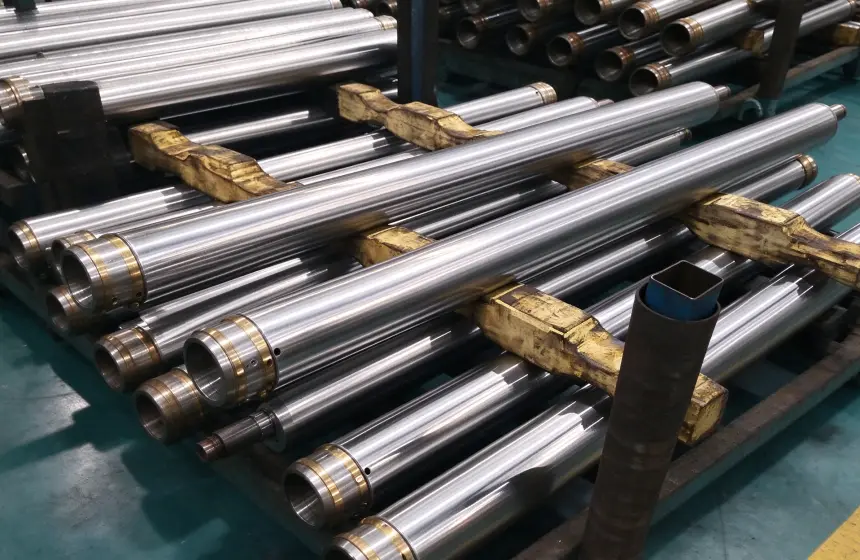
The Root of Film Sticking: Surface Energy Matching, Not Contamination
Film sticking is often blamed on dirty rolls. Cleaning offers temporary relief but merely resets the system. If the baseline condition already sits within the adhesion window, sticking returns during continuous production.
From surface physics, the work of adhesion between roll and film follows:
Wa ≈ γ roll + γ film − γ interface
When roll and film surface energy closely match, interfacial energy drops and adhesion increases. Better wetting creates stronger bonding and harder separation.
This explains common field observations:
- Freshly cleaned, activated chrome rolls may stick worse
- New rolls run well initially; sticking develops over time as surface energy shifts
- Identical chrome rolls work for PP/PE but stick with PET or PA
Typical surface energy values: PP / PE film: 29–31 mN/m; clean polished hard chrome roll: 36–42 mN/m; PET / PA film: 41–45 mN/m.
For PP/PE, the energy gap keeps adhesion manageable. For PET and PA, nearly identical surface energy creates a high-risk sticking zone. Whether chrome works depends entirely on your film type.
Two Critical Operating Boundaries
Surface energy control is not simply “lower is better.” Two boundaries define your usable process window. Crossing either causes defects.
Upper Boundary: Adhesion / Sticking Boundary
Higher surface energy matching increases adhesion, leading to:
- Film scuffing and higher haze
- Longitudinal streaks and uneven stretching
- Peeling noise at high line speeds
- Web blocking after winding and tearing during unwinding
Excessively low surface energy reduces friction transfer, resulting in:
- Tension fluctuations and web wandering
- Roll-to-film slip and loss of MD stretch control
- Wider film gauge variation
This surface energy operating window is dynamic; it shifts with temperature, line speed, tension and film grade.
When Hard Chrome Alone Fails
Single hard chrome struggles to maintain a stable window in these scenarios:
1.High-surface-energy films (PET, PA, coated substrates) requiring intentional surface energy mismatch
2.Elevated temperatures that boost polymer mobility, amplify adhesion and narrow the safe window
3.High-speed thin-gauge films where concentrated pressure and heat demand stable dyne performance
4.Long continuous runs, where chrome surfaces cycle through activation, oxidation, contamination and wear
5.Formulations with migrating slip agents, anti-block additives and oligomers that unpredictably alter surface energy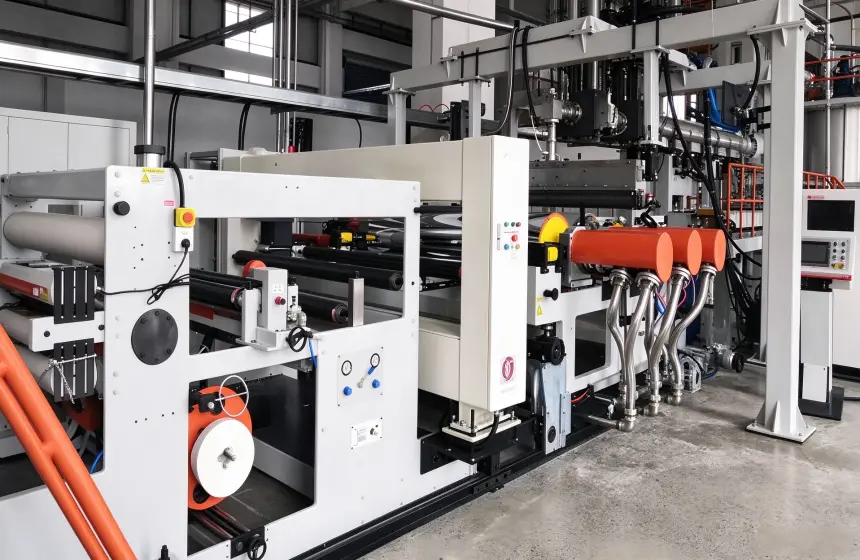
Three Technical Routes for Stretch Roll Surfaces
Route 1: Retain hard chrome with surface energy tuning
Keep the chrome substrate and add functional surface modification:
- Long-life low-surface-energy topcoats (fluorocarbon, silicone) below 20 mN/m to create energy mismatch for high-energy films
- Controlled passivation / oxide formation to stabilise surface energy and reduce drift
- Regular dyne or contact angle testing instead of visual gloss inspection
This option keeps capital cost low, yet coating uniformity and service life remain critical.
Route 2: Upgrade coating systems
- Ceramic coatings (Cr₂O₃, Al₂O₃, TiO₂): Excellent wear resistance but inherently high surface energy; evaluate carefully per film grade
- DLC (Diamond-Like Carbon): Low friction and chemical inertness, ideal for sticking-sensitive web processes
- Composite structure: Ceramic base + low-energy topcoat, balancing wear and release
Route 3: Decouple traction from release
Separate traction and release functions:
- Handle web traction via wrap angle, tension profiling and pinch rolls
- Optimize roll surfaces purely for low adhesion without relying on surface friction for web drive
When traction does not depend on roll friction, surface energy can safely decrease and widen the sticking-free operating window.
Practical Field Recommendations
1.Maintain roll surface energy logs: record dyne/contact angle data for each roll, not just “hard chrome plated.”
2.Track new and used roll performance: capture readings at clean state, 500 h and 2000 h to map surface energy drift.
3.Cleaning is maintenance, not design: it cannot permanently control your surface energy boundary.
4.Set film-specific standards: PET and PP require different surface energy specifications.
5.Factor in temperature: safe windows change between startup and steady-state, summer and winter.
6.Separate traction and release evaluation: first confirm traction can be achieved independently before setting minimum surface energy.
Closing Thoughts
Hard chrome plating delivers proven mechanical performance: wear resistance, corrosion resistance and regrindability. It cannot define or stabilise your target roll surface energy, which drifts over runtime.
Treating sticking only as a cleanliness issue means fighting a constantly shifting boundary.
The right approach is to define your operating window: stay below adhesion thresholds and above traction limits. Hard chrome works only when your process stays inside that window. The key question is not whether the roll is chrome plated — but whether its surface energy profile matches your process.
- Is Hard Chrome Plating Enough for Stretch Rolls?
- Explosion proof electric roller
- The Silent Quality Drivers: How High-Precision Rollers Shape Release Film Perfor
- What Are the Benefits of Hard Anodized Aluminum Guide Rollers?
- Why High-End Manufacturing Cares So Much About Roller Surface Precision
- Why Your Heavy-Duty Conveyor Needs Garland Idler Rollers
- What are the differences and applications between anilox roller and embossing ro
- Why Teflon Coated Aluminum Rollers Are the Best Choice for Non-Stick Web Handlin