
Phone: +86 15398058207
E-mail: sales@astraroll.com
Add: Room 603 Building C, The Huixin Center, Zhangba One Road, Yanta Zone, Xi'an City, Shaanxi Province, China
Choosing the Right Air Shaft for Web Handling
In web-handling production, the air shaft is a small component with a large impact on efficiency. It determines how quickly operators can load and unload rolls, how evenly tension is distributed, how stable the web runs, and how consistently the line repeats from one roll to the next.
At AstraRoll, we work with converters, printers, coaters, and equipment builders who need air shafts matched to their roll cores, line speed, tension, and handling method. The starting point is understanding the main air shaft types and where each one fits.
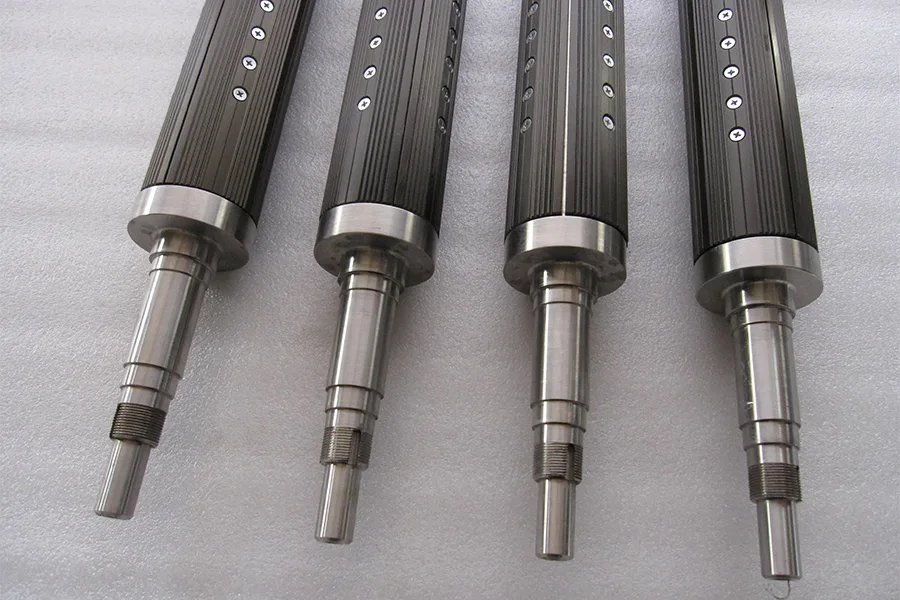
Why Air Shafts Matter in Roll Handling
An air shaft uses air pressure to expand and grip the inside of a roll core, then releases when air is removed. Compared with mechanical chucks or fixed shafts, this gives fast roll changes, uniform grip around the core, and less risk of core damage.
The right shaft design helps with:
- Fast loading and unloading
- Stable tension during unwinding and rewinding
- High repeatability between rolls
- Protection of paper, film, foil, and other sensitive webs
- Reliable performance at higher line speeds
Four Common Air Shaft Types
1. Keyed Air Shaft
A keyed air shaft expands through keys or lugs when inflated and retracts when deflated. It is a high-precision winding shaft designed for slitting, printing, coating, and similar roll-to-roll equipment.
Key characteristics:
- High expansion force
- Uniform force distribution
- Smooth rotation
- Good repeatability
- Suitable for many types of roll cores and web materials
Keyed air shafts are a practical choice for general converting and winding applications where grip strength and reliable repeatability are important.
2. Slip-On Air Shaft
A slip-on air shaft contracts quickly after deflation, making roll loading and unloading convenient. It provides strong support, runs smoothly, and helps avoid damage to the core.
Typical applications:
- Printing machines
- Slitting machines
- Coating machines
- Laminating machines
- Wide-web, large-diameter, and heavy-load winding
Slip-on shafts are particularly useful where operators need fast roll changes and the line handles large or heavy rolls.
3. Tile-Type Air Shaft
A tile-type air shaft locks by air pressure and returns to position after deflation. The tile or lug design provides a large contact area and stable tension, with low risk of core damage.
Where it fits:
- Printing, slitting, coating, and laminating lines
- High-precision winding
- High-tension operation
- Long roll lengths
When the process demands stable tension and careful core handling, a tile-type air shaft is often a strong candidate.
4. Carbon Fiber Air Shaft
A carbon fiber air shaft uses a high-strength carbon fiber tube as the main body. The result is a shaft that is light in weight, rigid, and resistant to rust.
Best suited to:
- High-speed printing
- Film slitting
- Lithium battery production
- Precision coating
- Other high-end web-handling equipment
Carbon fiber shafts can reduce rotating weight and help improve handling and speed performance on advanced lines.
How to Choose the Right Air Shaft
The correct shaft is not simply the most expensive or the most specialized option. It should match the actual production conditions. AstraRoll typically reviews the following points with customers:
- Roll core inner diameter and tolerance
- Maximum roll weight and roll diameter
- Web width and material type
- Line speed and tension requirements
- Loading and unloading method
- Shaft length and mounting interface
- Required expansion force and repeatability
- Operating environment
For wide, heavy rolls, a slip-on or keyed shaft may be appropriate. For high-precision, high-tension work, a tile-type shaft may be better. For high-speed film, lithium battery, or precision coating lines, carbon fiber can offer advantages in weight and rigidity.
Custom Air Shafts from AstraRoll
AstraRoll provides custom machining for air shafts and related web-handling components based on customer drawings and application requirements. Our focus is on precise fit, stable quality, and practical delivery.
Our custom service covers:
- Air shafts for slitting, printing, coating, and laminating equipment
- Machining to customer drawings
- Shaft bodies, journals, and mounting interfaces
- Application-specific expansion structures
- Export-ready wooden case packaging for safe transport
We understand that an air shaft is part of a production system. A small dimensional error or unsuitable expansion design can cause downtime, core damage, or inconsistent tension. That is why AstraRoll reviews the application details before production and works to deliver a shaft that fits the line, not just the drawing.
Common Industries and Equipment
Air shafts are widely used in:
- Slitting machines
- Printing presses
- Printers
- Coating machines
- Paper machines
- Leather processing machines
- Laminating and packaging equipment
Different machines place different demands on shaft weight, grip force, tension stability, and roll-change speed. AstraRoll can help match the shaft type to the equipment and material.
Keyed, slip-on, tile-type, and carbon fiber air shafts each have a clear role in web handling. The best choice depends on roll size, weight, core type, tension, speed, and how often operators change rolls.
If you are specifying an air shaft for a new machine or replacing a shaft that is causing tension problems, core damage, or slow changeovers, AstraRoll can help. Send us your drawing and application details, and our team will recommend a practical air shaft solution for your line.
Contact AstraRoll to discuss your custom air shaft requirements.
- Choosing the Right Air Shaft for Web Handling
- Industrial Cleaning Brush Rollers Factory
- Industrial Brush Rollers Factory
- Three common industrial applications of brush rollers
- Is Hard Chrome Plating Enough for Stretch Rolls?
- Explosion proof electric roller
- The Silent Quality Drivers: How High-Precision Rollers Shape Release Film Perfor
- What Are the Benefits of Hard Anodized Aluminum Guide Rollers?