
Phone: +86 15398058207
E-mail: sales@astraroll.com
Add: Room 603, Building C, Huixin Center, No.1 Zhangba Road, Yanta District, Xi'an, Shaanxi, China
4 Critical Air Shaft Selection Mistakes That Ruin Your Flexible Packaging Winding
Posted by AstraRoll | Web Handling & Converting Expertise
A flexible packaging converter in Guangdong, Mr. Li, replaced three air shafts within one year. All three failed in exactly the same way: offset rolls and edge wrinkling during high-speed winding. Customer returns piled up, and he asked us bluntly: "Are all air shaft suppliers building the same faulty product?"
The truth: the shafts themselves were not defective. When we visited his site, we found the root cause was poor selection. He ran PET film at 350 m/min, yet fitted a standard key-type air shaft. It gripped the core firmly, but no consideration was given to dynamic balance and radial runout for high-speed operation. Vibration and roll wobble were inevitable.
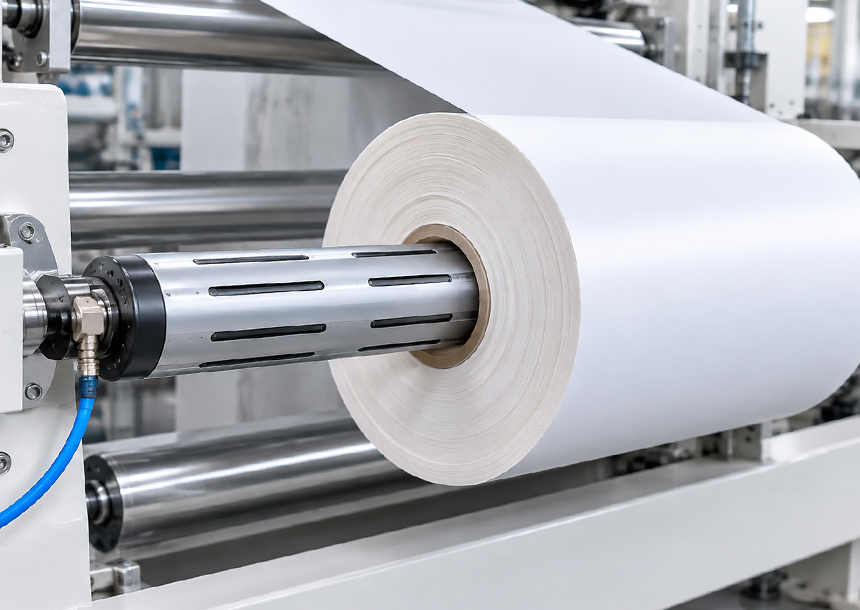
This case is far more common than you think. With 20 years in the air shaft and roller industry, we have seen countless wrong choices. Most are not caused by dishonest suppliers; they come from unclear requirements on the converter’s side. Below are the four most frequent pitfalls. Save this checklist before your next air shaft inquiry.
Pitfall 1: Only focus on gripping force, ignoring core strength
This is the #1 mistake. Buyers often ask only: “How much gripping force can this air shaft deliver?” Many assume higher force equals better performance.
That is wrong. If expansion force exceeds the paper core's load limit, cores crack, crease internally, and the finished roll becomes unstable. We have seen cores split open before even going onto the machine.
Best practice: Confirm core thickness and material first. For standard 3-inch cores thinner than 8 mm, keep gripping force moderate. For heavy composite and slitting lines, tile-type / leaf-type air shafts are recommended. They distribute pressure evenly and treat thin cores gently.
Pitfall 2: Use the same shaft for unwind and rewind
Unwind needs stable tension; rewind needs precise roll formation. Many factories simplify inventory by fitting key-type shafts across the whole line, which leads to uneven roll edges on the rewinder.
- Unwind station: Light load, frequent speed changes. Standard key-type or leaf-type shafts work well. Prioritize fast inflation and quick roll change.
- Rewind station (especially slitting & rewinding): Requires tight, aligned roll ends. Choose differential / slip air shafts. They compensate tension differences between individual narrow rolls and prevent tapered “bell-shaped” reels.
Rule of thumb: unwind for simplicity, rewind for precision. Do not interchange them blindly.
Pitfall 3: Quote only shaft diameter, forget line speed and dynamic balance
Mr. Li's problem perfectly illustrates this. Buyers list diameter, length and gripping force, but cannot state maximum line speed.
For speeds above 200 m/min, dynamic balance (G6.3 or higher grade) and tight radial runout control are mandatory. A shaft may look straight statically, yet oscillate like a pendulum at high rotation. This issue is hard to settle after delivery, since it was never specified in the original order.
Pitfall 4: Fit standard shafts into non-standard operating conditions
Some production environments are harsh: next to high-temperature ovens, corrosive atmospheres, or ultra-wide web widths. Still, customers pick standard catalogue shafts.
Standard shafts can be customized, but you must share working conditions upfront. We adjust materials (aluminum alloy / steel), sealing components and surface treatment accordingly. Do not wait until the shaft seizes up and then mention "our operating temperature hits 80°C."
The 5-item checklist to send AstraRoll before ordering
Fill this out and send it to our engineers, and we can deliver a suitable proposal within 30 minutes, cutting your selection failure risk by nearly 90%.
- Application: Unwind / Rewind / Slitting & Rewinding?
- Shaft diameter & expansion range: Core inner diameter (3" / 6"), expansion tolerance
- Line speed: Maximum m/min, dynamic balance requirement
- Load: Maximum finished roll diameter and weight
- Working environment: Temperature, corrosion, custom web width
If you are struggling with wrinkled, offset or tapered rolls, your problem may not be the shaft quality - it may be the wrong specification. AstraRoll specializes in precision air shafts and industrial rollers for global flexible packaging, film and converting lines. Reach out with your checklist, and we help you pick the right air shaft for your web.
- What Makes Precision Industrial Rollers Different from Standard Rollers?
- 4 Critical Air Shaft Selection Mistakes That Ruin Your Flexible Packaging Windin
- AstraRoll Custom Industrial Rollers
- 5 Signs Your Industrial Rollers Need Maintenance or Replacement
- Industrial Rollers Material Guide
- How to Choose the Right Industrial Rollers for Your Conveyor System
- Slip Shaft vs Air Shaft: The Two Must-Know Rewind Shafts for Slitting
- Air Shafts – The Unsung Backbone of Automated Web Production Lines