
Phone: +86 15398058207
E-mail: sales@astraroll.com
Add: Room 603 Building C, The Huixin Center, Zhangba One Road, Yanta Zone, Xi'an City, Shaanxi Province, China
How Does an Anti-Deflection Structured Roller Work?
In wide-web manufacturing—whether in paper production, film coating, metal cold rolling, or textile calendering—uniform nip pressure is everything. To achieve a flawless finish, your rollers must maintain perfectly flat, parallel contact from edge to edge.
However, as production webs get wider and hydraulic loading forces get heavier, machinery faces a severe law of physics: Mechanical Deflection.
When multi-ton forces are applied to the two outer shaft ends of a standard hollow roller, the metal body naturally bends or bows outward by fractions of a millimeter. This creates high pressure at the edges and a loose gap in the center, leading to uneven coating streaks, moisture pockets, and web wrinkling.
The Anti-Deflection Structured Roller is engineered specifically to eliminate this problem. Here is how it balances heavy loads to maintain a dead-straight profile.
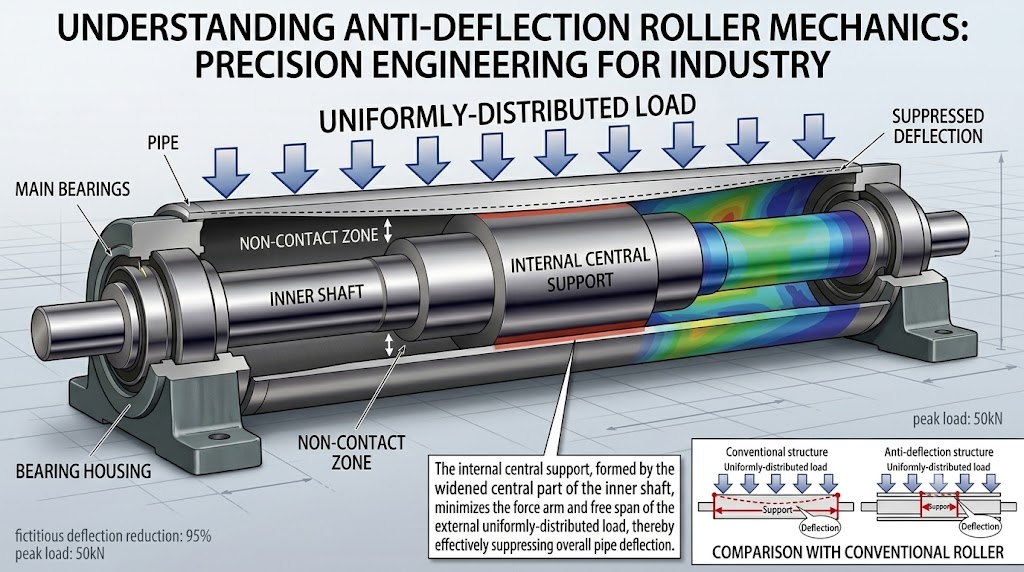
The Internal Mechanism: Core vs. Floating Shell
Unlike a standard single-tube roller that curves under load, a high-performance anti-deflection roller splits the mechanical burden into a dual-component system:
1. The Internal Shaft (The Load Bearer)
At the dead-center of the assembly sits a massive, solid forged alloy steel inner shaft. When hydraulic rams apply heavy operating tonnage, 100% of that bending force is transferred onto this internal core. The inner shaft absorbs the strain and deliberately deflects inside the assembly, leaving the machine frame unaffected.
2. The External Floating Jacket (The Working Surface)
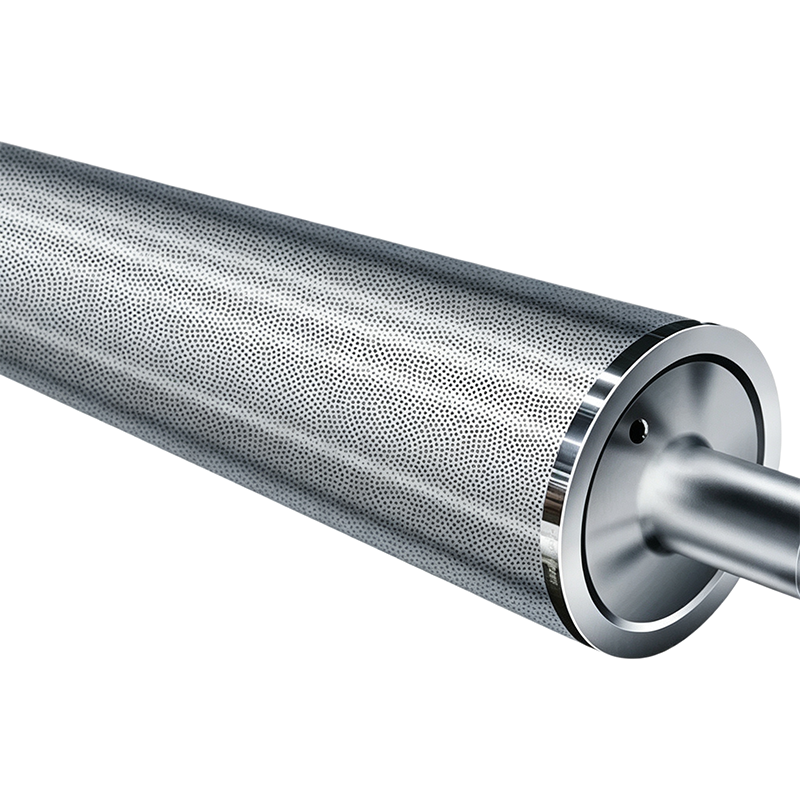
Hovering completely over the bending inner shaft is a perfectly straight outer shell milled from premium SUS304 or SUS316L Stainless Steel.
This outer shell is isolated from the main hydraulic rams, floating smoothly over the inner shaft via specialized internal bearings or multi-point hydraulic oil supports. Because the inner core handles all the deflection, the outer stainless steel drum remains 100% dead-straight and parallel, delivering completely uniform linear nip pressure across the entire web.
Alternate Solution: Precision Crown Grinding
For specific continuous-load applications, deflection can also be corrected through mathematical shaping known as Parabolic or Sinusoidal Crown Grinding.
Using high-precision CNC cylindrical grinders, the center diameter of the roller is machined slightly thicker than the ends.
- When Idle: The roller profile features a subtle barrel or "crowned" shape.
- Under Full Payload: As operating pressure is applied, the roller elastic-flexes just enough to flatten out into a flawless, dead-straight cylinder across the material web.
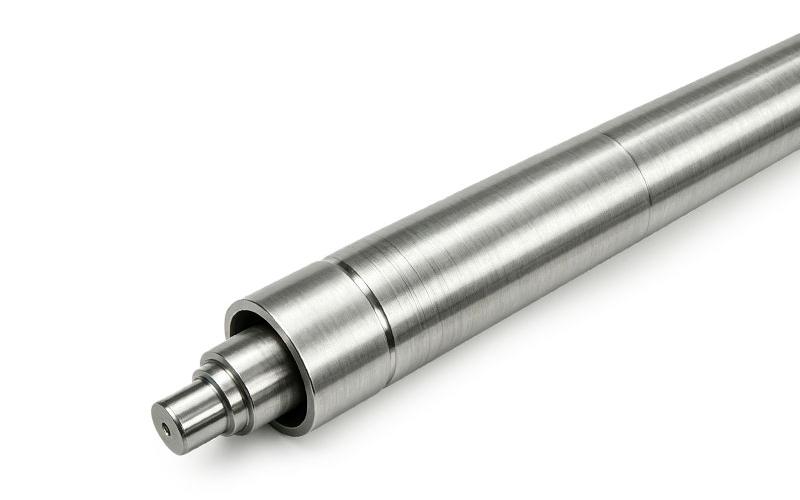
The AstraRoll Advantage: Heavy-Duty Performance
AstraRoll custom-engineers each anti-deflection profile to match your machine's exact hydraulic load vectors and environmental demands:
- Eliminate Web Defects: Forcing 100% uniform linear pressure stops center-slack, wrinkles, and gauge bands.
- SUS316L Corrosion Armor: Built to survive high-humidity and chemical environments, such as paper mill wet ends and textile dyeing lines.
- Mirror-Chrome Finish: Glass-smooth surfaces eliminate web drag and protect sensitive optical films or thin metal foils from scratches.
- ISO G1.0 High-Speed Balancing: Calibrated on dynamic rigs, our rollers operate at terminal line speeds with zero high-frequency vibration.
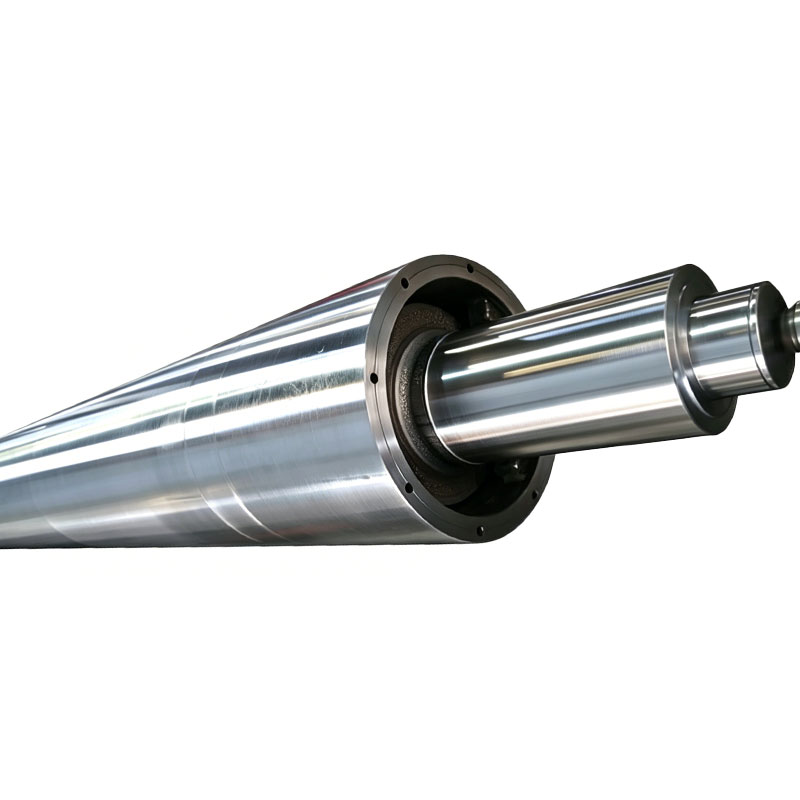
Optimize Your Web Profile Control
In wide-web processing, maintaining flat profiles directly dictates your daily throughput and material yields. Stop fighting uneven pressure distribution and premature bearing wear.AstraRoll executes every order directly from your CAD blueprints, custom-compounding internal stiffness or crown compensation to perfectly counter your machine's hydraulic tonnage.
Ready to permanently eliminate roller deflection?
Submit your drawings and request a technical engineering quote directly on our official AstraRoll Stainless Steel Anti-Deflection Roller Page today!
- The Silent Quality Drivers: How High-Precision Rollers Shape Release Film Perfor
- What Are the Benefits of Hard Anodized Aluminum Guide Rollers?
- Why High-End Manufacturing Cares So Much About Roller Surface Precision
- Why Your Heavy-Duty Conveyor Needs Garland Idler Rollers
- What are the differences and applications between anilox roller and embossing ro
- Why Teflon Coated Aluminum Rollers Are the Best Choice for Non-Stick Web Handlin
- How to Eliminate Static Accumulation and Defect Risks in High-Speed Battery Sepa
- What Are Hard Coated Rollers?