
WeChat: 15398058207
E-mail: sales@astraroll.com
Add: Room 603 Building C, The Huixin Center, Zhangba One Road, Yanta Zone, Xi'an City, Shaanxi Province, China
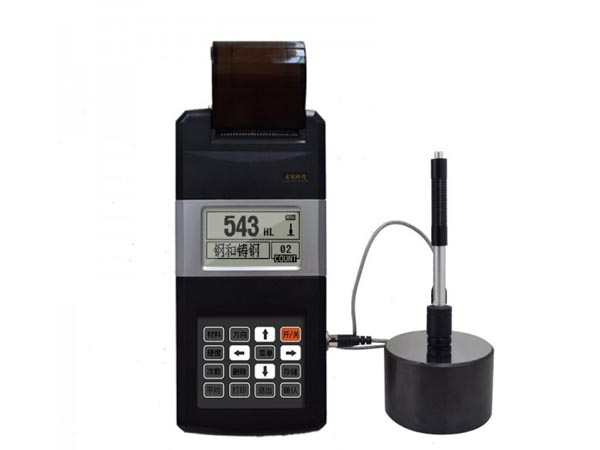
Leeb Hardness Tester
The Role of the Leeb Hardness Tester in Roller Manufacturing
Hardness is the silent specification behind every durable roller. A conveyor roller shaft that is too soft will wear at the bearing seats and journal surfaces; a drive shaft that is too hard may become brittle and fracture under shock load. That is why hardness control runs through every stage of roller production - and why the Leeb hardness tester has become the standard tool for verifying it on the factory floor.
What a Leeb Hardness Tester Is
The Leeb hardness test is a portable, rebound-based hardness method developed in the 1970s for testing parts that cannot be moved to a bench hardness machine. A small impact body with a carbide ball is released against the test surface under spring force; the ratio of its rebound velocity to its impact velocity is displayed as a Leeb hardness value (HL) . The harder the surface, the faster the rebound. With built-in conversion curves, the instrument reports equivalent values in Rockwell (HRC), Brinell (HB), Vickers (HV) and other common scales, so results can be compared directly with drawing requirements. The method is covered by international standards including ASTM A956, ISO 16859 and GB/T 17394.
Where It Fits in Roller Production
In roller manufacturing, the Leeb tester is used at four critical points:
1. Incoming material verification. Before machining, bar stock and forged blanks are spot-checked for hardness. This catches material that is off-spec or mis-labelled at the door, preventing a whole batch from being machined to the wrong condition.
2. Post-heat-treatment verification. Roller shafts are commonly quenched and tempered (调质) or induction-hardened on bearing seats, journal surfaces and drive keyways. After heat treatment, every critical surface is tested: the Leeb tester confirms the hardening depth region reached the specified hardness (typically 40–55 HRC for shaft journals, and higher for induction-hardened surfaces), while the core remains tough.
3. Surface-layer and coating checks. For rollers with hardened or coated surfaces - induction-hardened tracks, chrome-plated shells, thermal-sprayed layers - the tester verifies surface hardness without cutting a sample, and can be used to check uniformity along the roller length.
4. Final inspection and traceability. At final QC, hardness readings are recorded per roller and included in the inspection report, giving customers documented proof that each shaft meets the specified hardness range.
Why the Leeb Method Is Preferred in Roller Shops
- Portability - it travels to the workpiece: long roller shafts, heavy welded drums and installed assemblies can be tested in place, no cutting or transporting.
- Speed - a reading takes seconds, allowing 100% testing of critical surfaces rather than sampling.
- One-sided access - the test is made from a single side, essential for bores, keyways and assembled parts.
- Minimal surface damage - the rebound leaves no meaningful mark, so finished surfaces can be tested without rework.
Getting Reliable Readings
The Leeb method is forgiving but not casual. Reliable results require:
- Surface preparation - the test point should be smooth and free of scale, rust or oil (a fine grindstone pass or polish is standard).
- Correct support - thin or light parts must be backed or coupled to a rigid mass; a free-standing thin roller shell will read falsely low.
- Direction awareness - the tester's direction (downward, upward, horizontal) affects the reading; modern instruments auto-compensate or require the proper correction factor.
- Multiple readings - averages of 5–10 impacts per point are recommended, discarding obvious outliers, to smooth local variations in coarse or heat-treated surfaces.
The Verdict
The Leeb hardness tester is not a substitute for laboratory Brinell or Rockwell testing on calibration samples - it is the production-floor companion to them. Used correctly, it turns hardness from a batch-level laboratory claim into a per-roller, per-journal verified fact. At AstraRoll, every shaft's critical surfaces are Leeb-tested after heat treatment and recorded in the inspection report - because hardness is the quality the customer cannot see, but will feel in service life.
- Explosion proof electric roller
- The Silent Quality Drivers: How High-Precision Rollers Shape Release Film Perfor
- What Are the Benefits of Hard Anodized Aluminum Guide Rollers?
- Why High-End Manufacturing Cares So Much About Roller Surface Precision
- Why Your Heavy-Duty Conveyor Needs Garland Idler Rollers
- What are the differences and applications between anilox roller and embossing ro
- Why Teflon Coated Aluminum Rollers Are the Best Choice for Non-Stick Web Handlin
- How to Eliminate Static Accumulation and Defect Risks in High-Speed Battery Sepa