
Phone: +86 15398058207
E-mail: sales@astraroll.com
Add: Room 603, Building C, Huixin Center, No.1 Zhangba Road, Yanta District, Xi'an, Shaanxi, China
AstraRoll Carbon Fiber Coating Rollers – High Precision & Low Inertia
By AstraRoll – Professional Roller Supplier for Global Export
Coating lines run at high speed, where rollers are core web-handling components. Conventional metal rollers suffer from heavy weight, high rotational inertia, deflection, corrosion and wear, limiting maximum line speed and creating coating defects. As demand rises for premium coated substrates, carbon fiber (CFRP) rollers have become a preferred upgrade solution. AstraRoll delivers custom carbon fiber roller packages tailored to diverse coating working conditions, bringing measurable gains for high-speed, wide-web coating production.
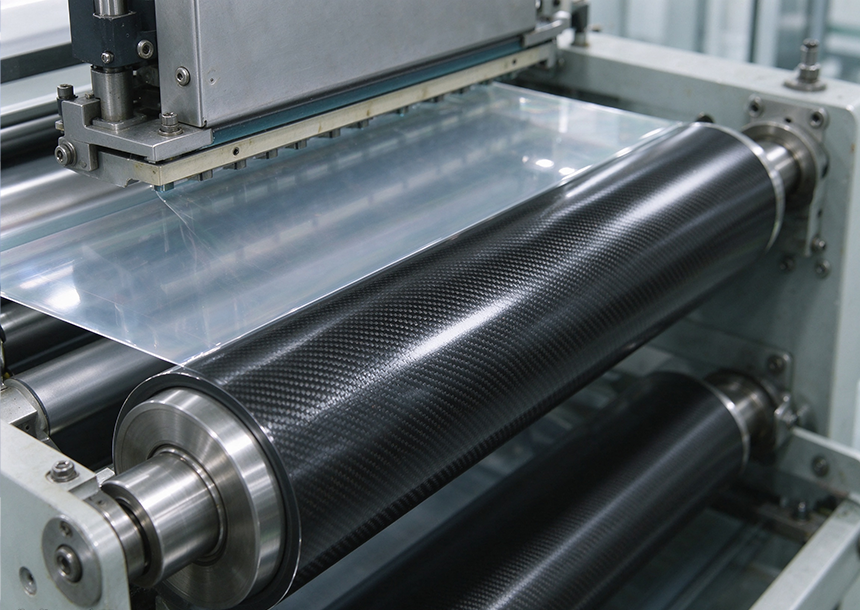
The core benefits of carbon fiber rollers for coating machines include low inertia with lightweight design, high rigidity and precision, outstanding dimensional stability, clean corrosion-resistant construction, controllable anti-static conductivity, energy savings, and compatibility with high-speed wide-format lines. Field data shows these upgrades can lift output by 10–25%, cut reject rates by 53%, and reduce energy consumption by 15–30%.
1. Lightweight & Low Rotational Inertia (Primary Advantage)
| Comparison Item | Carbon Fiber Roller | Traditional Metal Roller | Operational Benefits |
|---|---|---|---|
| Weight | 1/4 of steel rollers, 1/2 of aluminum rollers | Heavy | Lower motor load, 15–30% energy saving |
| Rotational Inertia | Extremely low | High | Fast response, supports 10–20% higher line speed |
| Start-Stop Performance | Smooth, rapid acceleration & deceleration | Slow, prone to substrate waste | Less material loss during speed changes, higher throughput |
| Bearing Wear | Greatly reduced | Severe | Bearing service life extended 2–3 times, lower maintenance cost |
Light CFRP construction minimizes mass and inertia, which is critical for coating lines with frequent speed adjustment and tight tension control.
2. High Rigidity & Precision Coating Control
Carbon fiber composites deliver 5–7 times higher specific strength and specific modulus than steel. Minimal bending deflection enables radial runout controlled within ±0.01 mm, stabilizing web tension evenly across the full width.
- Coating thickness tolerance improves from ±3 μm (metal rollers) to within ±1 μm
- Surface finish can reach mirror quality below Ra0.2 μm, preventing scratches on delicate films
- Available in lengths up to 10 m, breaking the length limit of metal rollers for ultra-wide coating lines
3. Dimensional Stability & Resistance to Deformation
Carbon fiber has a thermal expansion coefficient of roughly 1.5×10⁻⁶/°C, far lower than metal. It retains precision inside high-temperature drying ovens and avoids uneven web shrinkage caused by thermal expansion.
Excellent creep resistance guarantees stable geometry over long continuous runs, eliminating the common issue of metal rollers gradually bending with service time. Dynamic balancing grade reaches G2.5 or higher to suppress vibration at high speed, removing pressure fluctuations and streaking on coated surfaces. The high slenderness ratio design keeps deflection low, ideal for long-span guide roller systems on high-speed coaters.
4. Clean Performance & Corrosion Resistance for Demanding Working Conditions
Carbon fiber does not shed metallic dust, a key advantage for clean manufacturing of lithium electrode sheets, separators and optical films where contamination causes scrap.
CFRP resists acids, alkalis and common coating solvents to avoid chemical corrosion. Multiple surface treatments are optional, including hard chrome plating, tungsten carbide coating and non-stick finishes, to boost wear resistance and anti-fouling performance. Surfaces resist coating buildup, simplifying cleaning and shortening unplanned downtime.
5. Controllable Anti-Static & Conductive Properties
Through modified resin systems or conductive surface treatments, carbon fiber rollers can be tuned to resistivity from 10⁻³ to 10⁻⁶ Ω·cm for reliable static dissipation.
Controlled static removal prevents film sticking and dielectric breakdown. For lithium coating processes, static-related electrode damage can be reduced by 90%. Uniform conductivity across the roller surface delivers consistent coating thickness, making these rollers suitable for static-sensitive electronic and optical substrates.
6. Measurable Production Benefits & ROI
- Productivity: A leading separator manufacturer increased line speed from 60 m/min to 75 m/min, lifting output by 25%
- Quality improvement: Defect rate dropped from 3.2% to 1.5% (53% reduction)
- Operating cost: 15–30% lower power consumption, reduced maintenance frequency and 2–3x longer service life
- Process upgrade: Supports higher line speeds and stricter coating specifications to advance manufacturing capability
7. Coating Machine Types & Recommended Roller Positions
| Coating Machine Type | Installation Positions | Core Functions |
|---|---|---|
| Lithium Electrode & Separator Coater | Unwinding roller, tension roller, coating back-up roller, drying guide roller | Stable web support, uniform coating, vibration suppression |
| Optical Film Coater | High-precision coating back-up roller, steering roller | Thickness control, web deviation correction |
| Paper Sizing Coater | Sizing roller, coating roller, doctor beam roller | Even sizing, less coating waste |
| Flexible Display Film Coater | Ultra-thin coating control roller, anti-static guide roller | Ultra-thin coating precision, static elimination |
Final Selection Tips from AstraRoll
When selecting carbon fiber rollers for coating applications, evaluate line speed, web width, operating temperature, solvent chemistry, anti-static requirements and target coating tolerance. AstraRoll’s engineering team provides fully customized CFRP roller solutions, including tube layup design, surface coating, shaft end assembly and dynamic balancing to match your coater specs.
If you are upgrading from steel or aluminum rollers for high-speed coating, contact AstraRoll for technical drawings, samples and quotation.
- AstraRoll Carbon Fiber Coating Rollers – High Precision & Low Inertia
- Carbon Fiber Rollers for Paper Machinery | AstraRoll: Boost Efficiency & Quality
- Carbon Fiber Rollers vs Metal Rollers: Key Performance Advantages | AstraRoll
- What Makes Precision Industrial Rollers Different from Standard Rollers?
- 4 Critical Air Shaft Selection Mistakes That Ruin Your Flexible Packaging Windin
- AstraRoll Custom Industrial Rollers
- 5 Signs Your Industrial Rollers Need Maintenance or Replacement
- Industrial Rollers Material Guide